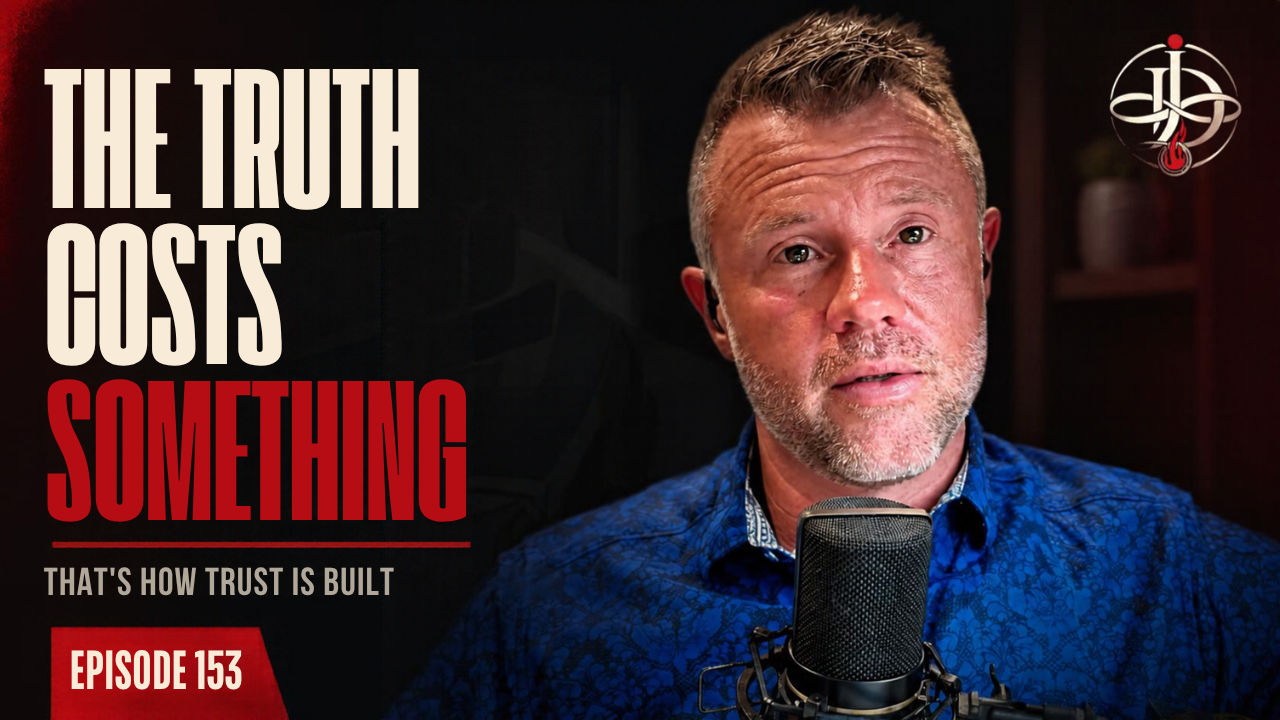
Why She Doesn't Feel Safe With You (Even Though You'd Never Hurt Her)
Oct 12, 2026Prefer to listen? Hear the full episode here.
Ask most men whether their woman feels safe with them and you'll get a quick answer. Of course she does. I'd never hurt her. I'd never cheat on her. I'd step in front of a truck for her.
All of that matters. It's the floor. A woman can't relax around a man who might harm her, and any man worth anything holds that floor without thinking about it.
But there's a layer of safety underneath the physical one that almost no man accounts for, and it decides whether she ever truly lets go in his presence. It's whether she can tell him the truth. And the answer depends far more on him than on her.
My conversation with GS Youngblood last week got me thinking about this. Creating safety is one of the three elements of his Masculine Blueprint, and after we stopped recording I kept turning it over. Most of us as men think we understand safety. I don't think we do. And I think the missing piece lines up exactly with the thing I've called my highest value for years: the truth.
The default is hiding
People will lie to you unless they feel safe enough not to.
That sounds cynical until you look at your own life. Hiding is the default setting for human beings. When someone doesn't feel that you can receive what's real for them, they tell you what you want to hear. They say what keeps you calm, what keeps you close, what keeps them out of trouble with you. And the more they love you, the stronger that pull gets, because the more they have to lose.
Everyone you love has edited themselves for you at some point. Probably today. Usually with no malice in it at all.
We all learned this before we could talk. Some feelings brought warmth and attention. Others brought a cold face, a raised voice, a parent who left the room. A child doesn't need many repetitions to sort the two, and by adulthood the sorting runs so fast that nobody notices it happening. We just say the acceptable version and call it being nice.
So when I talk about safety, this is the layer I mean: an environment where people aren't punished for telling the truth, where they don't have to edit themselves around you. That goes for your wife, and it goes for your kids, and if you run a business, your employees. Anywhere you hold some power, the people around you are constantly reading whether the truth is welcome.
Safety, safety, safety
Martha Beck, the author and coach, once decided she would go one full year without telling a single lie. No white lies. No exceptions.
By the end of that year she had left the religion she was raised in. Her marriage was over. She'd lost her home. Most of her friends were gone. Her job was gone. From the outside, it looked like she had lost almost everything.
Here's how she described what it felt like: "safety, safety, safety." Like she'd finally reached the shore after swimming in a dark ocean her whole life.
How does a person lose nearly everything and feel safe for the first time? Because everything that left needed her to keep lying. It counted on her continuing to tell lies, believe lies, and live as though things that weren't true were true. All of it required maintenance. Constant vigilance, constant energy, constant management of what could and couldn't be said.
A life held together by a willingness to lie needs that maintenance forever. Truth is the only thing that holds itself up.
What we underestimate about her
As men, we vastly underestimate how much fear most women carry.
Start with the physical layer, because it's the one we can at least picture. She scans the parking lot before she walks to her car. She hesitates before stepping into an elevator with a stranger. She thinks about the route home, where her keys are, who knows where she is. Most women run that math every single day, and most men have never once had to.
That's only the first layer.
Men edit ourselves too. I'm not claiming women hide more than we do. But it lands differently in a woman. So many women learned very young that their truth cost them love: the girl who didn't want to hug the relative, who was angry, who wanted too much, who said the thing that made the room go quiet. She learned that being acceptable meant being edited. By the time she's grown, she can walk into a room, read a man in seconds, and know which parts of herself are allowed to show up. She adjusts before she's even aware of it.
Her body is running threat assessment on her own truth.
That's why, for her, the question of whether she can tell you something real is a nervous-system question. And a woman who has to keep watch over what she says can't fully let go. Her letting go is where her softness lives, and her wildness, and her desire. A man who wants those things has to understand that they only come out where the truth is safe.
If we as men are going to lead, it falls to us to initiate that. To build the space where the truth is welcome, and where she's never punished for saying what feels real to her.
Comfort and safety are different things
It's easy to confuse feeling comfortable with feeling safe. Especially when we're afraid of losing what we have.
Comfort is the absence of friction. Safety is knowing who you are and where you stand.
Keeping the peace is one of the things men do best, and it almost always means someone isn't telling the truth. When we don't want to rock the boat, we tell half-truths. We let things slide. We say "it's fine" when it isn't, and we push the real thing under the rug because we don't want to deal with what happens if we say it.
She feels that. She feels the gap between what you say and what's actually true for you, even when she couldn't put words to it. Something's off. Her gut knows before her mind does.
You can build a very comfortable relationship that is deeply unsafe. That's the state of most long-term marriages: no fights, no friction, and two people quietly managing each other.
The body knows
There's a clip of Martha Beck on Diary of a CEO where she has the host, Steven Bartlett, hold his arm out to the side and resist while she pushes down on it. He holds it easily. Then she has him say "I love to vomit" while she pushes, and his arm drops. She has him say "I love fresh air," and his arm holds strong again. Every time he says the lie, the strength leaves.
Dawn and I have used this kind of arm testing for years. It's become one of the ways we tune into what's actually true in our bodies, and where our lives or our beliefs have drifted out of line with what we know.
I'd hold it loosely. It's a way to listen to your body, and I wouldn't make big life decisions on it alone. But it makes one thing very visible: every time you swallow the truth, your body pays for it. You get weaker. And that weakness doesn't only make you untrustworthy. It makes you feel untrustworthy, from the inside, and the people around you pick up on it.
Why she can't trust a man who keeps her comfortable
If you're willing to lie to keep the peace, you aren't a trustworthy man. And a woman's body cannot fully let go in the presence of a man she can't trust, no matter how kind he is, no matter how hard he works, no matter how much he loves her.
Every time you soften the truth a little to manage her reaction, you're managing her. That's control, wearing the costume of kindness. Underneath it is fear of what the truth would cost you.
A lot of men believe they're making her safe by never upsetting her. Look at what that actually produces. A woman who is never upset because her man keeps reality away from her is being handled. Somewhere underneath, she knows she's with someone who won't tell her the truth, and she can't rest there.
The man who tells her hard things is the only man whose words she can learn to trust. When she knows you'll say the thing even when it's uncomfortable for you, she can finally believe the good things you say too. She can trust your presence, because she knows nothing is hiding behind it.
You don't earn her trust by being agreeable. You earn it by being real when it costs you something.
Going first
Someone in the relationship has to take the risk of telling the truth first. As a man, that's you. That's what leadership actually is.
The next time you feel yourself backing down because you don't want to deal with the fallout, notice it. Then ask what it would mean to say the thing anyway. If you need a doorway in, try something like this:
"I'm a little afraid to say this right now because I'm afraid of how you'll react. But if I don't say it, I'm not telling you the truth, and I want you to be able to trust me."
Then say it. Tell her what you see. Tell her what you want. Tell her what isn't working for you. Tell her what you're afraid of.
And then let her have her reaction. It's hers. Her displeasure, her hurt, her being upset: none of that is yours to manage or control. Shutting down your truth to keep her reaction small isn't leadership. It's manipulation, even when it's done with the best intentions.
Clean truth and weaponized truth
Some men will hear "tell her the hard thing" as permission to unload on her. So it's worth drawing a line here.
Truth told clean has nothing riding on it. You aren't trying to win, punish her, prove a point, or make her change. You're giving her accurate information about you: what you see, what you feel, what you want, where you stand. She can do whatever she does with it.
Weaponized truth is aimed. It carries a verdict, a hook, a demand. The words might even be accurate, but the purpose is control, and she'll feel the purpose far more than the words.
The simplest test is to ask yourself, before you speak, what you're hoping it will do. If the answer is "let her know where I actually stand," it's probably clean. If the answer is "make her feel what she made me feel," or "get her to finally admit it," or "win," it's a weapon. Put it down and find the truth underneath it, which is usually something more vulnerable.
Clean truth tends to speak from your side of the line: I see, I want, I'm afraid, this isn't working for me. Weaponized truth tends to speak about her: you always, you never, you're the kind of woman who.
Clean truth can still upset her. That's fine. Upset and harm are different things, and a woman can feel upset and safe at the same time when the man in front of her is steady and honest.
What it cost me to say
I started a business when I was twenty-five. By forty-one I had sixteen years invested in it. It had gone really well for me, and it would have been easy to coast in it for another twenty years.
But I couldn't do it anymore. It was killing me. Saying that out loud cost me something, and I started saying it a few years before I actually left.
There was a harder truth underneath it, one I had to admit to myself first. I'd always told myself that business gave me purpose, that it was meaningful to me. The truth was that I chose that line of work because I wanted to make a lot of money and thought it was the easiest way to do it. I didn't care about it. I didn't care about the customers. Frankly, I didn't even care that much about my employees. I'd layered a sense of meaning on top of a choice that never had any.
Admitting that to myself was the beginning of the end for that business, and for everything in my life that was built on it.
When I finally walked out that door, did I feel like I'd lost something? Not for one second. It still gives me chills to remember how free I felt.
The same capacity runs both ways
If you can't say the hard thing, you probably can't hear it either.
When you know from the inside what it costs to speak a scary truth, you develop real respect for anyone who takes that risk with you. To the person speaking, it can feel monumental. And when you've become someone they feel safe enough to say it to, you'll honor it instead of punishing it.
Most men punish it without realizing they're doing it. She says something about you or the relationship that was hard for her to say, and you get defensive, or hurt, or cold, or you argue her out of her own experience. Every time that happens, she learns you can't handle the truth. So she edits herself for you. And eventually she may leave, and still not tell you the real reason. She might not even admit it to herself.
Here's a big one for men: if you need her approval to feel okay, you will lie to keep it. Half-truths, avoidance, lies of omission, whatever keeps her approval coming. And when she withdraws it, you'll punish her for it.
The steadiness to hear her comes from feeling safe enough in yourself that her truth can't knock you over. When she brings you something that was hard to say and you can answer with something like, "Thank you for telling me. That must have felt vulnerable to say," and then not get upset with her for it, she learns that her truth doesn't break you.
That builds trust. She feels safe enough to let more of herself out. And then you get to meet the woman you fell in love with all over again.
Why the truth brings the fire back
Think about why the beginning of a relationship is so hot.
At the beginning, we show up more fully as ourselves. We speak the truth more. We share what we want. We haven't started fearing the loss of the other person yet, so we're less edited and more honest. That's a huge part of what makes new love burn the way it does.
Then the fear of losing love kicks in, and the small lies start. The managing starts. Two people slowly replace themselves with edited versions, and edited versions don't excite anyone.
When you become a man who can receive her truth and tell her yours, you make it possible for the version of her you fell in love with to come back. The more alive version of her. The more sexual version of her. The one you've probably been craving whether you realized it or not.
That's how a relationship that has been withering comes back to life.
What the truth costs, and what it can't
I'll say two things that sound contradictory. Telling the truth never costs you anything real. And telling the truth will always cost you something.
Both are true. The truth will cost you things: comfort, approval, maybe a job, a house, friendships, even a relationship. What it can't cost you is anything that was actually meant for you. You don't control what belongs in your life. The only thing you control is whether you're honest, and then you let the chips fall where they fall.
If you tell the truth and the thing leaves, you'll be safer for it. If you tell the truth and the thing stays, you'll know it was meant for you.
Dawn and I have lived this. Ten years ago we lived in a big house. I owned a fairly large business and made a lot of money. We had a ton of friends and a great reputation. As I started following what was true for me, and Dawn started following what was true for her, the house stopped fitting. The business stopped fitting. A static life in one place stopped fitting.
Today we live full-time in an RV. When I recorded this episode we were in South Carolina, and a few weeks from now we'll be somewhere else. We have very few friends, in large part because of how we live. We don't own a home. In a lot of ways, our relationships with our families have changed too. Nearly everything in our life that wasn't built on the truth is gone.
And it doesn't feel sad. It feels right. Letting go of something you were fighting to hold together, something that was never meant for you, doesn't feel like a loss once it's gone. It feels like setting something heavy down.
People tell us they admire our relationship and want what we have. What they don't always see is that we were willing to lose each other in the process. Our marriage has stood up to the truth surfacing again and again, through some of the hardest challenges and biggest fires of our lives. That's exactly why we know it can't break.
What survives the truth is the only thing you can actually build on. And a relationship where both people can tell and live the truth, even when it's hard, is the safest place a human being can live.
Where to start
Admit the truth to yourself first. Get a journal, open a document, or start a note on your phone. Write down the things that feel true that you've been afraid to say. The hardest ones are the truths you've stopped letting yourself admit at all, and the longer you've stuffed them, the harder they are to find.
Try the arm test with a friend. Maybe not your spouse at first. Practice resisting while they push down, then say "I love to vomit" and feel what losing strength is like. Then try a statement about your own life, something like "I'm meant for the career I'm in," and notice what happens. Treat it as a way of listening, not a verdict.
Say one true thing out loud. Pick something you've been holding back to keep the peace, and say it. Use that doorway sentence if you need it. Say it clean, with nothing to win and no one to punish. Then stay, and let her have whatever she has.
Go first. If you want her to feel safe with you, don't try to get her to tell you the truth. You do it. It may cause some upset in the short term. In the long term, the only man she can truly feel safe with is a man she can tell the truth to, and he becomes that man by telling his own.
When you start, you'll feel something loosen inside you. Some relief. Maybe the feeling Martha Beck described, of reaching the shore after a lifetime of swimming in the dark.
That's what safety feels like from the inside.
Listen to the full episode: On our website | Apple Podcasts | Spotify | YouTube
Mentioned: Martha Beck, The Way of Integrity
Last week's conversation with GS Youngblood: Powerful at Work, Powerless at Home
Go deeper with us: Free resources | Courses and coaching
We offer a variety of group programs, self study courses, and 1:1 coaching for individuals and couples looking for support in living healthy, loving D/s Dynamics.
Click here to learn more about the different programs and courses we have available!
Our Top 7 Tips for a Rock Solid D/s Dynamic
Free for you! Enter your name email below and we'll send it right over.
We will never sell, share, or trade your information, for any reason.
