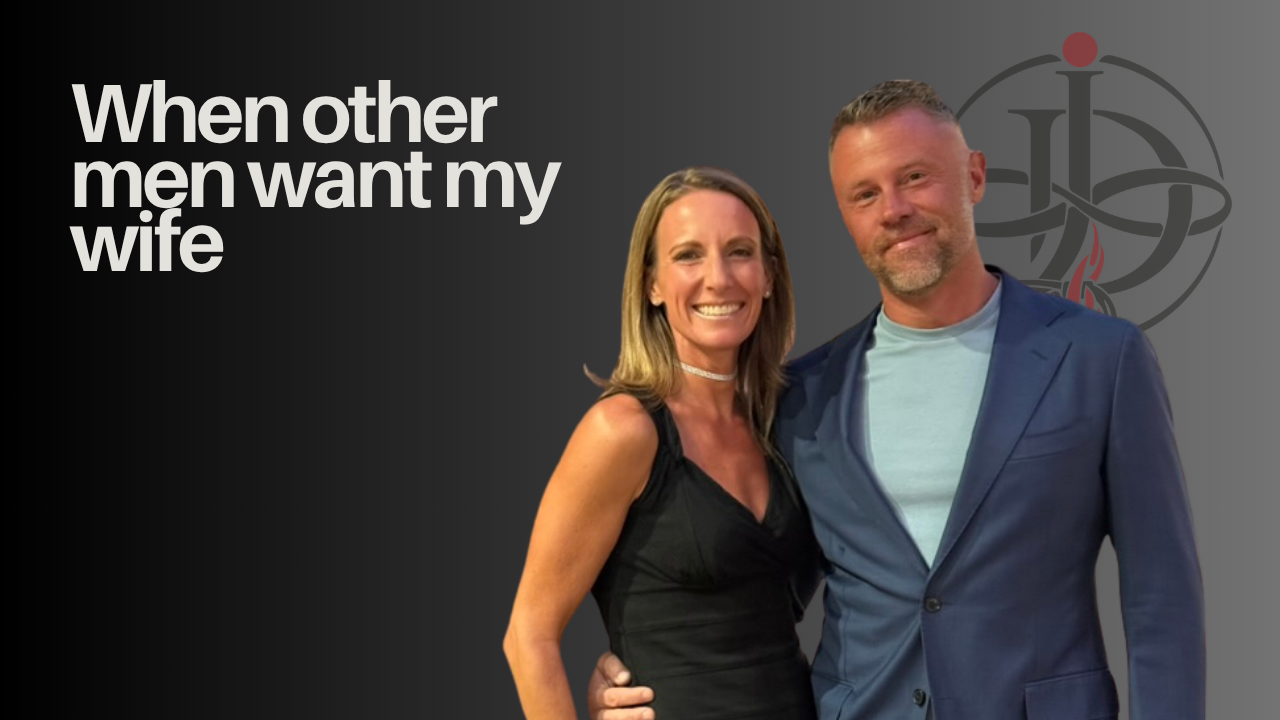
Why I'm Not Threatened When Other Men Want My Wife
Sep 28, 2026This post goes with Episode 151 of the Infinite Devotion Podcast, where Dawn interviews me. You can listen on the podcast page, Apple Podcasts, Spotify, or YouTube.
Dawn sat down across from me with a list of questions and wouldn't tell me what was on it. She said some would be light and some would go deeper. Within five minutes we were both crying.
That's how it goes in this marriage. We sit down to have a nice little chat, and the truth shows up and takes over.
The week before we recorded, I posted a line on Instagram, written to Dawn: I don't want you to be mine. I want you to be free and choose to stay. On Instagram the response was mostly warm. On Facebook the post reached over a million people in two or three days, and a lot of them were furious.
One comment summed up what many of them were feeling: Giving someone that much freedom in a relationship will turn even the best person into a bully. You'll just end up getting abused and taken for granted. Someone else, who clearly knew our history, asked a sharper question: Does that mean her collar is coming off?
This post is my full answer to both. It's also the first time I've told the whole story of what happened on a beach in Los Angeles seven months ago, when I asked Dawn to stand up.
What I love about myself
Dawn opened by asking what I love about myself.
The honest answer is almost too big to be useful. I've come to know, as deeply as I know anything, that I am love. So is she, and so is everyone. So what I love about myself, at the root, is that I am. That's a very short answer, though, so here's the one underneath it.
I love that I can hold ideas I don't agree with. I can look at a principle or an ideology or a belief that I don't think is true and still find what's true inside it, because I know there's something in it for me. I don't throw ideas out. I go looking for the part that's real.
Sometimes that means holding two opposing views in my mind at the same time without needing to resolve them. For most people that's deeply uncomfortable, and the mind wants an answer immediately. I've learned to let the tension stay open until life answers it. The contradiction is where I learn.
The other thing I love grows out of that one: I can synthesize. I take a little from spirituality, a little from psychology, a little from lived experience, and a little from philosophy, and I find what they have in common. A coach I hired years ago called me a "master simplifier," and it was the first time someone had put words to something I'd always done. I take complicated things and make them clear enough to live by.
Dawn got emotional hearing that, because she said it's what I brought into her life. She described learning to sit inside cognitive dissonance and let life teach her the truth, instead of grabbing the nearest answer that would make the discomfort stop. She's taught our kids the same thing. Watching someone you love take on something you've practiced your whole life, and make it more fully hers than it ever was yours, is a quiet kind of reward.
What I love about her
Then she asked what I love about her. I teased her for fishing for compliments. She said she just wanted to hear what would come out of my mouth.
What came out was her courage.
I don't think anyone except me will ever fully understand how brave Dawn has had to be. She grew up inside a belief system that went all the way down. She was told as a small child that questioning it would get her thrown into fire forever. Then she married a man who questioned everything, and she followed me into a way of seeing life that required her to challenge who she believed she was, over and over, for years.
Every time she let me show her something new, it broke something she'd built her identity on. She had to love herself enough to question all of it. And she had to trust me enough to believe the questioning was worth it.
I don't take that lightly. I think it's one of the most impressive things I've ever seen a human being do, and it happened quietly, mostly in our bedroom and our kitchen and our truck, with no one watching.
I also told her I love her tits. She said I made her cry and then made her laugh, and that's about right. She also said that my love for her body, in every form it's taken over the years, has been part of how she's come to accept it. For women especially, in a culture that picks their bodies apart, being adored consistently across decades does something that no amount of self-talk can.
The life I dreamed and then built
Next she asked what I enjoy most about the life I dreamed up and then brought her into. When it was only a dream, it lived in my head. Now it's the life we wake up in.
Part of it is the novelty of living on the road. The morning we recorded, I'd gotten a haircut in central Kentucky from a guy who was very central Kentucky. I texted Dawn afterward: I think I've had enough Kentucky now. I'm ready to go. And we get to go. By my next haircut we'll be 1,200 miles away. The characters, the scenery, the constant newness keeps me awake to my life.
The bigger answer has to do with the book.
About 48 hours before we recorded, I finished the manuscript for Infinite Devotion. It comes out November 10. The whole book is my testimony on one question, the one that's driven almost everything I've built with Dawn: how do two people get closer, more intimate, and more sexually alive over the long run, instead of slowly turning into roommates?
That question sounds like it's about behavior, and it isn't. It's about identity. To answer it, you have to question what it means to be human, what it means to be a man, and what it means to be a woman. It runs all the way down.
What I love most is that we get to live inside that question together. We keep exploring, keep finding new things, keep opening to ourselves and each other in new ways. One of my clients once used the phrase "permission to evolve," and I've never forgotten it. I get to look at my wife and tell her: I don't care who you become, how you show up, or what you want to try on in your life. I'm here. I'm your biggest cheerleader.
I've spent my whole life trying to put what that feels like into words, and it still escapes me a little.
"I don't want you to be mine"
That's where Dawn brought up the post and the commenter who asked about her collar.
First, a quick note on where the line came from. I saw I don't want you to be mine. I want you to be free and choose to stay credited to a poet. When I went looking for the poem, it didn't exist. That's why I didn't attribute it. I don't know who wrote it, but I know it's true.
Here's why. Unless there is real freedom in my partner, all I ever get is a limited version of her.
If I'm telling Dawn, I need you to be like this, never do that, always do this, I've handed her a set of parameters. From then on she has two choices: fit my requirements perfectly, or abandon herself to earn my love. Either way, the woman in front of me is a version of Dawn built to keep me comfortable, not Dawn herself.
I know this because I used to do it. I used to tell her, You can't want that. You have to do this. I need this from you. I need you to never do that. And then I'd wonder why I couldn't fully find her.
When both people are doing this to each other, which is true of most couples, nobody is actually there. Dawn compared it to the song "Dance Monkey." Picture two monkeys circling each other, each watching the other to figure out what they have to do to avoid getting in trouble. If you do that, I have to be this way, because I don't want to upset you. Two people performing for each other in a loop, each believing that's what love requires.
The fear underneath the comments
What struck me about the Facebook response is how many people believe, down in their bones, that their partner would hurt them if they stopped controlling them. I have to control you, or you'll hurt me.
That belief deserves a real answer, not a dismissal.
Look at what it assumes. It assumes the person you married is dangerous by nature, held back only by your rules and your monitoring. It assumes love is a leash and the only thing between you and betrayal is your grip on it. If that's what you believe about your partner, the problem isn't the amount of freedom. The problem is that you're sharing a bed with someone you think is an enemy.
The same belief does something else too. Control breeds exactly what it fears. A person living under constant requirements eventually builds a private life somewhere else: resentment, secrecy, the things they stopped telling you. The controller then finds evidence that they were right all along, and tightens the grip. That's a closed loop, and I've watched it slowly kill marriages from the inside.
On the episode I said I don't need boundaries to protect myself, because I'm not living in self-protection. I don't tell Dawn what she's allowed to do or what I'll tolerate. She can do whatever she wants, because my love for her is deeper than her actions. And that doesn't make me a doormat.
That last sentence deserves more than I gave it in the moment, because it's the real answer to the critics.
A doormat is someone who stays out of fear. He puts up with anything because losing the person feels unsurvivable, so he abandons himself again and again to keep them around. His lack of boundaries comes from dependency.
What I'm describing is the opposite. I don't need Dawn to stay, and I'm not afraid of her leaving. That's exactly why I'm not a doormat. The freedom runs both ways. The same freedom that lets her choose to stay every day is the freedom I live in too. A man who isn't afraid of losing his wife has no reason to put up with anything that requires him to abandon himself. He doesn't need a rule against it. He simply doesn't live that way.
Most boundaries are rules for someone else's behavior, set to keep us from feeling something we're afraid to feel. When the fear is gone, the rules have nothing left to guard.
It's also worth saying plainly that none of this works between two people who are still at war with each other. What we live grew out of years of both of us doing the work. If you're with someone who is actually hurting you, the answer isn't to hand them more freedom and hope. The answer is to reclaim your own freedom, including the freedom to go.
The collar, and the day I asked her to stand
So, to the person who asked if Dawn's collar is coming off: that's up to her. It's not up to me.
Here's the part we'd never fully shared.
For about seven months now, a few sharp-eyed people have noticed that Dawn's collar changed from silver to gold. The change happened on a beach in Los Angeles, on the day between our anniversary and her birthday.
For weeks before that, we'd been talking about total surrender. What it really means to let go all the way. What it would mean for her to surrender completely to my will, not as a performance or an obligation, but as a whole woman choosing it.
On that beach, her collar came off. She knelt, and I removed the silver one.
Then I offered her the gold one, which stood for a new depth of surrender. And I told her to stand up.
I said: I'll put this one on you if you want it. But I'm going to put it on you standing up, not kneeling.
For almost eight years, basically every collar change we'd done had happened with Dawn on her knees. (A couple of times, both exhausted at the end of a long night, I took it off while she was washing her face so we could get to bed. Life is life.) Kneeling was how we'd always marked it.
This time I wanted her to make the choice upright. If she wanted to give herself to me that completely, I wanted her standing in her full height when she did it. So the collar is on her because she wants it on her. The moment she doesn't, it comes off.
What it meant then, and what it means now
I have to be honest about what the collar meant to me in the beginning. It always had depth. From the first conversations I could see there was something sacred in what I was asking her to step into. But it was also mixed up with my reasons for wanting this kind of relationship at all, and some of those reasons were plainly selfish. Part of me wanted control so that I could finally get my way.
Over the years, the collar has become one simple thing to me: a physical representation of her surrender.
Since the gold one, it means something more specific. It means she has committed to surrendering to me all the way. And I can't demand that, force it, or earn it by being clever. It's a choice only she can make. The collar reminds me, every time she pushes back, every time something gets hard, that she chose to put it on. As long as she keeps it on, I'm going to act as though it means what it means.
Dawn's side of it
Dawn added something on the episode that I think is the most important part of the whole story.
She said being asked to stand felt like standing up inside herself. Energetically, she's still on her knees, in reverence, admiration, and devotion. But standing meant claiming herself. It meant being whole.
Challenging everything had forced her to see where she'd been living in codependency, even inside our dynamic. Where she'd gone along with something just to make me happy. Where her surrender had really been people-pleasing. Where "obedience" had been obligation.
She said something people who have never lived this way need to hear: the dynamic is the relationship. It isn't a game we step into on weekends and out of on Monday. It's how we live. So every place she'd abandoned herself inside it was a place she'd abandoned herself inside our marriage.
Through our relationship, she said, she found herself. She found her own existence. She lived for most of her life as if she didn't matter, and now she matters to herself. From that wholeness, she chooses to surrender and to follow. She called it a recommitment, but more real than it could ever have been at the start. What we had then wasn't meaningless. It's just so much more meaningful now.
The distinction matters to every woman reading this, whether or not she has any interest in a structured dynamic. Surrender from self-abandonment and surrender from wholeness can look identical from the outside. Inside, they are opposites. The first is a woman disappearing so she can be loved. The second is a woman who knows she can pick her voice back up at any moment, and so she's free to lay it down.
A woman can't really surrender to a man until she trusts herself. The gold collar went onto a woman who does.
She also admitted there have been moments when she's had to stare at that collar and remind herself of what she chose. That's what a real commitment looks like. It isn't the absence of resistance. It's a reminder you chose for the moments resistance shows up.
(Somewhere in there she also told me I stare at myself in the mirror a lot, and I told the world about her duck face, which she insists she doesn't make. She does. We're still married.)
There are no contradictions
Dawn then went back to where she came from, and to a question she's been asking me since we left the church together.
When we met, she was still in church and I wasn't. When we started dating, I went with her, and eventually we left together. At 37 she was untangling a belief system she'd been inside since before she could talk, and she remembers practically begging me: Who is God? What is God? Help me understand.
I don't remember my exact answer, but it was something like God is an experience. She remembers wanting to shake me. Sir, I just need an answer.
So on the episode she asked the bigger version. How do I see the spiritual, the emotional, the physical, the human, masculine and feminine, and freedom fitting together?
I can give it to you in two sentences, both of which I learned from Ayn Rand's philosophy of Objectivism.
There are no contradictions.
If something seems like a contradiction, check your premises.
Everything makes sense. If something doesn't make sense, it means I'm holding a belief somewhere that isn't true. So when two things seem to conflict, the answer isn't to defend the belief I already have. The answer is to go looking for the premise that's wrong.
That's why I've said so many times on this podcast that you have to be willing to question everything. Your identity, your religion, your beliefs, why we call the sky blue. The truth is my highest value, and that isn't an abstraction for me. "The truth shall set you free" is only half the sentence. The other half, the part nobody says, is that you have to be willing to find it, which means being willing to be wrong about things you were sure of.
So contradictions are the most valuable things life can hand you. Each one points straight at a lie you're holding.
When Dawn felt one thing in her body while the church told her another, and she lived tangled in Am I going to heaven? Am I going to hell? How am I supposed to be?, that tension wasn't a sign she was broken or faithless. It was a flag planted directly over an untrue belief.
The same goes for the conversation I keep seeing online about "my truth" versus "the truth." People argue about it as though one has to win. Check your premises. When you find the right ones, those two stop contradicting each other.
Mind first, or body first?
Dawn pushed me here, and it's a fair push, because so much of our work is about embodiment. When I say it all makes sense, does it make sense in the mind, or in the felt experience of the body?
For me, it usually starts in the mind.
It starts with asking the question and challenging the assumption. Finding the place where something is off takes focused thought. You have to hold your own life up to the light and look at it honestly, until you can say, I might be wrong here. Maybe the church's explanation for everything isn't the whole truth. Maybe the things I was told never to question are exactly the things I most need to question.
That takes enormous courage, because the fear doesn't care that it's outdated. When you were three and they told you questioning this would send you into a fire forever, that fear gets into your body. It doesn't leave just because you're 37 and have decided you're allowed to think for yourself. Dawn cried a lot of tears over that.
Here's the part I want to say carefully, because it's easy to mishear.
The popular somatic advice right now is trust your body. Just listen to your body. I understand why people say it, and in a healed person it's true. A body that has been lied to for decades, though, is a body that's terrified. It's holding every place where you've been lying to yourself. If you ask that body what to do, it will keep saying no, be afraid, don't go there, because that's what it learned to say to keep you safe.
In that state, your body doesn't need you to trust it yet. It needs to learn to trust you again.
The fear lives in the body, and it's the body's fear that sends us up into the head, where we build explanations and rationalizations and do the mental gymnastics needed to keep believing a lie. The mind is where the mess got built. So sometimes the mind is where you have to go first, to look at the mess and admit it: I'm doing that. I'm believing that. It might not be real.
Taking that structure apart creates enough presence to stand in front of something that has terrified you your whole life. And then comes the skill I started this whole conversation with: holding two conflicting things at once. This feels terrifying. And: It might not be true. You sit there. You don't run to a story, and you don't force a resolution. You let the answer arrive in its own time.
Then, and only then, it starts to make sense in the body. The body can't settle into a truth it hasn't been shown yet. Most people spend their lives avoiding that dissonance. The path runs straight through it.
Faith, rescued
That brought Dawn to faith.
In the church she grew up in, "faith" was the word you reached for whenever something didn't add up. When you found a contradiction in the Bible, or two teachings that couldn't both be true, the answer was faith. Stop asking. Let it go. Faith meant disregarding the question.
I ran into that at 13. I was in my Wednesday night Catholic education class, CCD (I still don't know what it stands for), and I kept asking questions nobody could answer. Eventually they told me, We just don't ask those questions.
I said okay, stood up, and walked out. I sat on the curb in the dark until eight o'clock, when my mom came to pick me up. I got in the car, went home, and never went back.
I don't think faith is the enemy, though. I think the word was stolen.
To me, faith is what you do in the place where two things don't make sense yet. The old kind of faith said these don't fit, so stop looking. Real faith says these don't fit, so there's something I don't understand yet, and I trust life to show me. It's trusting that life has you. It's knowing you don't need the answer right now to feel okay or to feel safe.
What makes us feel safe, in the end, is the truth. Being able to tell it, live by it, say it out loud, and hear it from someone else even when it hurts.
Nobody can feel fully safe while they have to lie, or ignore a lie, or override the gut feeling that says something's off. There's no safety in hiding. And that goes straight back to relationships: there's no safety in a relationship where one person has to lie about who they are so the other can feel okay.
The hardest version of that work, and the most important, is finding where you've lied to yourself.
Male, man, and masculine
Dawn then brought up the soul, the body, and gender. There's the spiritual idea that the soul has no gender, and then there's the fact that in these bodies we clearly do. She quoted Kindergarten Cop ("Boys have penises and girls have vaginas") and asked what I've come to understand about all of it.
I haven't always gotten this right. I've had a fairly clear picture for a long time, and I've still had to correct myself. In November 2025, sitting in an Airbnb in Phoenix, I saw a hole in what I'd been teaching about women's emotions and how men receive them. It was big enough that I recorded an episode about it almost immediately.
For years I'd taught that a woman's emotional expression is her feminine at work. Her heart gives, and her feelings pour out as truth, and a man's job is to receive them. All of that is still true. What I'd missed is that not everything that comes out of her is expression.
When a woman is expressing, she's telling the truth about this moment: what she's receiving, what she's feeling, what's happening in her body right now. It flows. It doesn't need a target or a strategy, and it doesn't ask for anything. It's information offered freely, and a present man can lead from it.
When she's reacting, she is also putting feelings into the room, but they belong to the past. The feeling underneath is real, and it's always accurate to something. What comes out, though, is the defense built around it. A reaction is always trying to do something: secure, control, prevent, punish, or extract something from him or from the moment. It's fear speaking with the vocabulary of honesty. From the inside it feels completely sincere, and she'll say she's just expressing how she feels. The tell is that it wants an outcome.
I've always said that the old charge has to come out. Decades of unfelt feelings have to move through, and for a while that looks like storms. I still believe that completely. What changed in Phoenix is that I stopped calling the storms embodied femininity. Letting the old charge out is something that happens along the way. Embodied femininity is what's there once the backlog has drained and she's standing in the present moment: a heart giving honestly, in response to what it's actually receiving.
That distinction changed how I understood reactivity and emotional expression, and it changed what I tell men about receiving her. It's in the book too, and I think it's one of the most important lines in it. I also include it here because checking your premises applies to the teacher.
Much of the confusion around gender comes from treating three pairs of words as if they mean the same thing.
Male and female are biology.
Man and woman are something you become.
Masculine and feminine are energies, and every one of us carries both in equal measure.
In simple terms: masculine energy gives, and feminine energy receives. Every human being has both, fifty-fifty, always. The question that decides everything is which one you lead with.
A male becomes a man when he leads with his masculine: when he gives first, through action, direction, desire, provision, and presence, and receives through an open heart. A female becomes a woman when she leads with her feminine: when she receives first, through her body, her felt sense, and what she's being given, and gives from the fullness of her heart. The other half is still fully there and fully used. It just doesn't come first.
To live aligned and congruent, we each have to lead with the part of ourselves that matches our biology. That's what makes it expression and not a costume.
Nearly all of us come into adulthood the other way around. Men lead with the get. Women lead with the do. The whole machine runs backwards, and almost no one notices, because almost everyone they've ever seen was running backwards too. The book goes much deeper into this than a podcast episode can, and it's one of the parts I'm proudest of.
Do I get a blowjob every day?
Then Dawn took a hard left turn.
She'd done a Q&A recently (a safe-for-work version and a not-safe-for-work version), and one question comes up constantly, from everywhere: Does he get a blowjob every day? The assumption behind it is that a man who leads gets whatever he wants, and what he obviously wants is his dick sucked, several times a day.
No, I don't. And no, I don't want one every day.
I'll be honest: there was a version of me ten years ago who would have said absolutely. I'm not going to pretend that when we started down this road, part of me didn't think the dominant-submissive thing was going to mean a lot more blowjobs. For most men, if they're willing to admit it, that's the fantasy. The height of having a 24/7 submissive wife. I'm going to get my dick sucked every day.
That fantasy is the clearest possible example of leading with the get.
A man obsessed with getting is a man leading with his feminine: receiving first, needs first, what am I getting. In the language I used earlier, he's still a male, not yet a man. He hasn't grown into himself.
Look at what that does to her. If I come into our relationship leading with the get, I've put Dawn in a position where she has to give, whether she wants to or not, or else she's failing. She's not a good sub, not a good girl, not obedient enough. And if she's doing something she doesn't actually want to do because she's expected to, she has just abandoned herself to feed my neediness.
That never leads anywhere good. Not once, not in any relationship between two human beings.
There's also a second reason, which I only touched on in the episode, and which deserves an episode of its own. Every time I ejaculate, I empty myself. I don't want to do that all the time. More often it feels better to stay full than to have emptied myself. Many men have never considered that the drive to release as often as possible might be another form of leading with the get, and that holding their own charge changes what they bring into every room, including the bedroom.
A dead giveaway, for women
This gives women a practical filter. If a man says he wants to lead, or calls himself dominant, and everything he talks about is what he'll get, how often, and how much, he has shown you exactly where he stands.
He's counting on you to give first. He needs you to initiate, to supply, to take the masculine role. Only once you've given and he's received will he give anything back. That's leading with receptivity, however commanding he sounds. Whatever he calls himself, you would be the one in charge of the circuit.
What it actually is
On the episode I said, "If I wanted one every day, I'm sure I could get it." Dawn said, "You would." I said, "Good girl."
And that was enough.
It wasn't about getting a blowjob. What I received in that moment was her receptivity: her open, immediate yes. That lands in my heart, and it's all I need. When a man comes into himself, sex stops being about what he gets. It becomes something he gives: his presence, his attention, his direction, flowing to her, while he receives her in his heart. His fulfillment is feeling her come alive under his giving. From that place, even a blowjob becomes something I give to her, not something I take from her.
That's another conversation for another day.
Why I'm not threatened
That led to the question the title of this post comes from. Why am I not threatened by other men seeing Dawn and wanting her?
Because I don't want her to be mine. I want her to be free and choose to stay.
I like her alive. I like her full of life. Being seen and desired is one of the things that makes her come alive. Dawn shares her body and her sexuality openly through her own platform, Dawn of Desire, and a lot of men look at my wife. Some of them obsess over her. They message her. They want her.
None of that means anything about me.
If she chose to go, if she chose someone else, it wouldn't mean anything about me either. It would be her making a choice about her own life. And honestly, if she wanted to go, I wouldn't stop her. I'd probably help her. I don't think she's going anywhere. If she stays, I'll be damn glad to have her, because I like her.
That's the whole answer. It just runs against nearly everything most people have been taught love is.
The fire that lights up a marriage is the same current other people notice across a room. The frightened move, the one that has killed passion in millions of marriages, is turning that fire down until it can't threaten anyone. Keep it low. Keep it home. Keep it mine. A caged bird doesn't sing. The man who does that wasn't really asking for a passionate wife. He was asking for a wife who wouldn't leave, and he got what he optimized for.
Desire needs a freedom in which she could, in theory, choose otherwise. That's what makes being chosen mean anything. Two free fires, choosing each other every morning.
Marriage as a daily choice
Dawn added a memory from early in her questioning, when she was even taking apart the idea of marriage. Where did it really come from? Why do we do it this way?
We talked about choice. You have a choice every single day about whether to stay in a relationship with this person. The marriage license brings in the government. The ceremony brings in the church and "before God." Both add layers of obligation and conditioning on top of something that, at bottom, is a daily choice.
She said that's when freedom started settling into her. The odd part, she said, is that she's never once considered leaving. It has never crossed her mind. But she realized she'd never questioned it either, and something she's never questioned is something she hasn't fully chosen. So she questioned it. Now she doesn't stay because she signed a piece of paper. She stays because she wants to be with me, every single day.
That's the freedom. Words don't really capture it until you've taken these things apart inside yourself and let life show you what's true in them.
Where my understanding came from
Dawn's last question was about the people and places I've learned the most from.
Ayn Rand, for the two sentences that organize my whole way of thinking: there are no contradictions, and check your premises.
Peter Crone, the best simplifier I know. He can take enormous ideas and fit them into one line. My favorite: "Life will present you with people and circumstances to reveal to you where you're not free." Sit with that for five minutes and it will take your whole life apart. Everything you don't like, everything that makes you angry, everything you're sure is the problem out there is really showing you where you aren't free inside. He has a couple dozen lines like that, and each one goes straight to the heart. He's still my dream podcast guest. Peter, if you ever read this, I think we'd have a great conversation.
Chris Bale, @awakenedintent on Instagram, the only person I quote directly in the book. He was on the podcast last year, and he's one of the wisest people I know. When I feel off, I can listen to him talk about anything and I'm back in my own life and my own body. Sometimes I'm not even following what he's saying. It's the sound of his voice. It's his energy.
Sophie Josefina, who had us on her podcast about five years ago. Before that, she replied to one of my Instagram stories: "I love dom sub. It's such a pure polarity practice." One sentence, and something fell into place for me that I'd been circling for a long time. What we were living was never really about the structure. The structure was the laboratory where the physics of polarity became impossible to miss. She had no idea what that sentence did. I've told her since.
Christina, of Solar Feminine Arts, who has put words to my thoughts so many times, and just as often challenged assumptions I didn't know I had.
G.S. Youngblood, author of Masculine in Relationship, who joins me on next week's episode. Another voice that makes things very clear. I'm looking forward to that conversation.
And I couldn't finish that list without Dawn.
Every time she's been a pain in the ass. Every time she's been stubborn, moved slowly, dug in her heels, fought back, or screamed at me, and everything in between. That isn't all of it, and it sounds worse written down than it is. But all of it has mattered, because every time she pushed back, I had to ask myself a real question: Do I trust myself here? Is she showing me something I've missed? Or is she showing me she's afraid, and I need to hold my ground?
I've had to learn to trust myself a lot. I've also had to learn to see when she has a point. I've learned more from Dawn than from anyone, and it isn't close.
She said she didn't take any of that as negative. Joy and fun don't challenge us. The anger, the blowups, the friction are the gifts, because they're what show us more of ourselves. That's exactly what Peter Crone was describing, and exactly what a devoted relationship is for: one of the best places there is to become who you really are.
(And then she asked if I'd give her another economics lesson, like the two-hour one I once gave her on the money supply, free markets, gold, and Bitcoin. I said yes. She swore she wasn't glazing over. I'm choosing to believe her.)
If you want to hear this conversation in our own voices, including the parts where we couldn't stop laughing and the parts where we couldn't stop crying, you can listen to Episode 151 on the podcast page, Apple Podcasts, Spotify, or YouTube.
My book, Infinite Devotion, comes out November 10. Everything in this post, and much more, is in it.
For more, visit the blog, the free resources page, or everything we offer.
We offer a variety of group programs, self study courses, and 1:1 coaching for individuals and couples looking for support in living healthy, loving D/s Dynamics.
Click here to learn more about the different programs and courses we have available!
Our Top 7 Tips for a Rock Solid D/s Dynamic
Free for you! Enter your name email below and we'll send it right over.
We will never sell, share, or trade your information, for any reason.
