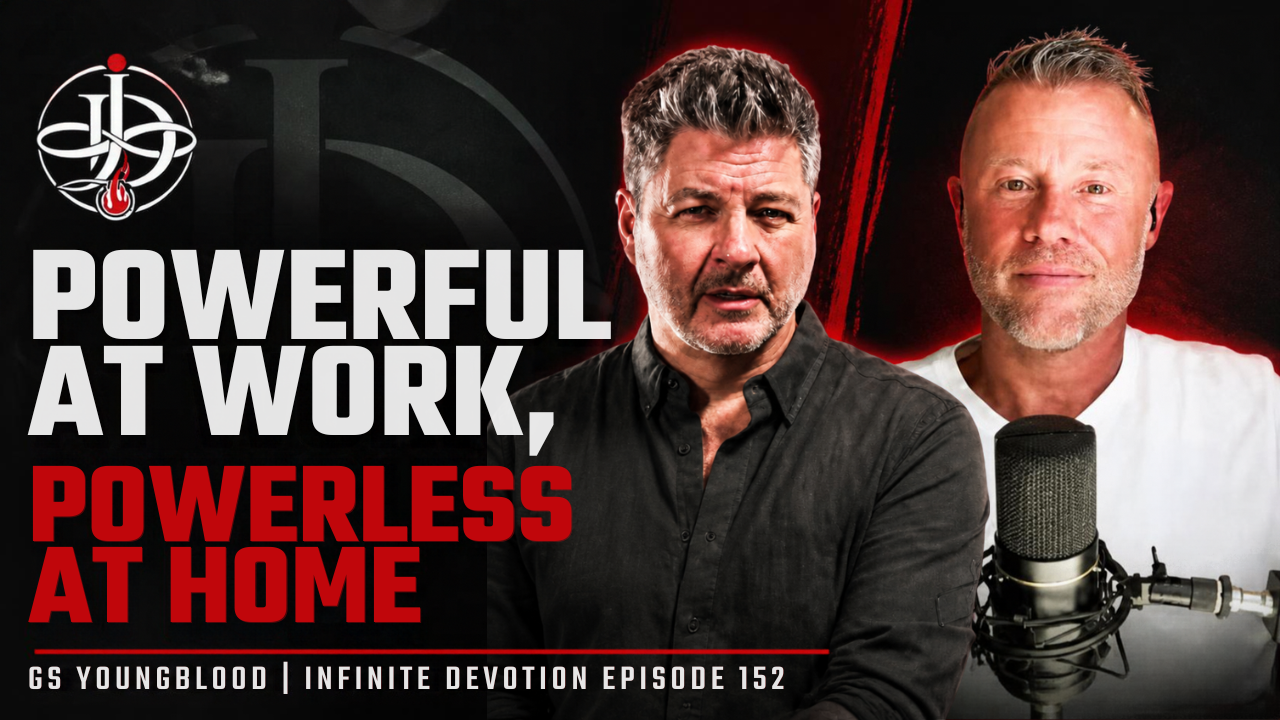
Powerful at Work, Powerless at Home: How to Lead a Strong Woman
Oct 05, 2026He runs a team of a hundred people. He makes calls under pressure every day, calls that move money and careers, and nobody in that building doubts him.
Then he walks in the door at home. His wife is upset about something. Within ninety seconds he is explaining, defending, apologizing for things he didn't do, or going quiet and waiting for it to pass.
I hear some version of this from almost every man who comes to me. "I'm so powerful at work, and I go home and I'm a pussy." Those are his words, and he says them with a kind of bewildered shame, because he can't figure out where the man from the office went.
This week on the podcast I sat down with GS Youngblood, author of The Masculine in Relationship and The Art of Embodiment for Men. He was my first guest in over a year. I've given his books away to more men than any other author's, and the reason is simple: he talks about this like someone who has lived it. He spent seventeen years in the tech industry, went through a divorce that left him feeling like a failure, and has spent the twenty years since studying and testing what actually works, including thirteen years in a relationship with a woman he describes as having a strong feminine and a strong masculine at the same time.
What follows is everything we covered, plus a few places I want to take it further than we had time for on the episode.
🎧 Listen to the full conversation: Apple Podcasts | Spotify | YouTube
Why the man from the office disappears
GS's answer to why men fold at home is empirical rather than theoretical, and I appreciate that about him. At work, everyone has agreed to be logical. Emotions get pushed out of the room and everyone speaks the same rational language. At home, you have a primal connection with a woman, and anything that touches that connection jacks up every moment.
I want to go one level down into why that is, because I think it's the key to everything else.
At work, the stakes are your job. At home, the stakes are older. When your woman is upset with you, her displeasure lands in the exact place your mother's did when you were four years old. Back then, her approval meant your survival. You were small and everyone had power over you, so you learned to read the room and get out of trouble as fast as possible. Your nervous system doesn't check what year it is. It feels the same emergency and reaches for the same strategy.
That's why the skills don't transfer. Think about this: at work, gathering input from the people you lead is smart leadership. You listen, you take their ideas into account, you make the call. Nobody thinks you're weak for it.
At home, the same behavior feels like collapse. You ask what she wants and some part of you feels like a pushover for asking.
The behavior is identical. The source is different. At work you're gathering information. At home, most men are seeking permission. When input-gathering comes from need, it's permission-seeking, and both of you can feel it. When it comes from your own ground, it's leadership, and she can feel that too.
So the question was never "why can't I bring my work skills home?" The question is "what in me is still four years old when she's upset?" Everything GS teaches is, in one way or another, an answer to that.
GS also made a point I want every man to hear. Bringing work mode home will fail. He learned this at Broadcom, an intense company where you had to be a killer to survive, and when he brought that energy home, his wife at the time told him flatly that it didn't work there. Home needs relational skill. The rational, get-it-done mode that everyone agreed to at the office doesn't speak the language of the woman you love.
And it goes the other direction too. What makes you better at home makes you better at work. Learning to feel connects you to your intuition. You make gut calls you would have missed. Your people feel heard, so they stay. GS put it well: strong spine, big heart. The heart sits on top of a spine that's already solid. I once heard someone say that the ability to feel is what gives a masculine man his oomph. A man who can do both is rare, and he's the one people follow.
Step zero: you are the solution
Before GS's framework, there's a step I start every man with: taking 100% responsibility for your life.
GS has a line in his book that says it perfectly: "I may or may not be the problem, but I am the solution."
The trouble is what a lot of men hear when you say "take full responsibility." They hear "it's all my fault." And they're tired of always getting blamed, so they resist. GS treats that resistance as a valid question that deserves an answer, and his answer is to move the man's attention off of whose fault it was and onto who's going to create the solution.
Here's what I notice about that. A man who hears responsibility as blame is still looking through the lens that's causing the problem. He's still trying to figure out whose fault it is. GS added the other version of that lens: "how can I make this not look like my fault?" That's the little boy again, wide-eyed, trying to spin it before dad gets mad. Every bit of defensiveness, explaining, and shutting down grows out of that one desperate question.
Responsibility, as GS and I both teach it, is a choice about who you are. You stand up and bring the two of you back to each other because that's the man you've decided to be. Whether you caused it doesn't change whether you can lead the way out of it.
The blueprint in one breath
GS's Masculine Blueprint has three elements:
- Respond versus react. This is about getting grounded.
- Provide structure. This is about leadership.
- Create safety. This is about physical, financial, and emotional safety.
His contention is that a man who embodies these three things daily lives from his masculine core. And when he does, the relationship improves in places he didn't even think were connected. She's less critical, less irritable, more interested in sex. Not because he found the right technique, but because she's feeling his groundedness, his leadership, and her own safety.
That word "embodies" matters. I asked GS about the difference between doing these things and embodying them, and he was clear: you can't do masculinity. If you just act more grounded, that's suppression. If you just start telling people what to do, that's bossing people around. The actual work happens underneath, in your nervous system and your inner clarity, and it takes longer than any man wants it to.
GS has tried to make it simpler without making it shallow: three things instead of thirty-two. He also warned against over-indexing on any one of them. The pure alpha who's all structure and no safety gets her attraction, but her heart never settles, so it doesn't last. The nice guy who's all safety and no structure has no edge, and it gets boring. The magic is all three together.
Element one: respond instead of react
GS describes the grounded man as having a stillness to him. You can feel it from across a room or in the way he speaks. He pauses before he acts. In that pause, he has enough inner space to witness who he's being, and then to choose what he actually wants to put into the space.
The opposite is the man frantically getting defensive every time his woman complains. The little boy getting out of trouble.
In my work, I see this as the four survival responses. He fights and lashes out. He flees and shuts down or leaves. He freezes with the deer-in-headlights look. Or he fawns, going along with whatever she wants to make it stop. For most men, reacting is so automatic that responding feels completely out of reach.
So how do you become conscious of a pattern that is, by definition, unconscious? Jung said it: "Until you make the unconscious conscious, it will direct your life and you will call it fate."
GS's answer is the most practical thing in the whole conversation. You can't do this at the mental level. Men make cognitive intentions: I won't be defensive this time, I'm going to really listen. And that intention flies out the window the minute fire shoots out of her eyes.
The only place this works is the body. A daily embodiment practice grounds your nervous system, and a grounded nervous system naturally gives you more space to witness yourself and choose. You aren't forcing the pause. The practice creates the room for it.
GS framed the whole thing this way. When she gets fired up, you get flooded with anxiety from your childhood wounding. That anxiety is uncomfortable. And every non-masculine reaction, whatever flavor it takes, is a desperate bid to make the discomfort stop. So the work has two sides. Increase your capacity to hold discomfort through embodiment practice. Reduce the amount of discomfort that floods in by healing the childhood wounds through therapy. Then add a coach to work on how you actually handle things in the moment. That's his trifecta, and I agree with him that leaving out any one of the three lets something sabotage the other two.
The trigger in front of you
A few weeks ago on the podcast, in How To Be Untriggerable (also on YouTube), I talked about what it takes to become an untriggerable man. The point I made there is worth repeating here.
The goal with the trigger you're in right now is to learn from it, so the next one lands differently. This one is here to teach you something. If all you do is try to escape it, you'll get the same lesson again next week.
GS approaches this through feeling. One whole module of his men's program is simply practicing feeling more deeply. Men who've spent decades suppressing emotion often find they can barely feel their shame, their hurt, their fear. Turning it up even 10% is a real step.
When you're both on fire
Often the man is reacting because she's reacting, and now neither of you is really there. Two wounded kids are interacting through two adult bodies. GS described a sculpture from Burning Man: two adults sitting back to back, facing away from each other, and inside them two children facing each other, trying to connect.
His rule for conflict: attend to the nervous systems first. If you don't, the content will never get resolved, because she can't hear you, you can't hear her, and you're both trying to get out of trouble.
So you lead the pause. Something like: "Whoa, baby, we're going downhill fast. Let's each take a walk around the block and come back in twenty minutes, because I really want to work this out with you and we're not getting anywhere right now."
That is emotional leadership.
Feeling without flooding
There's a strand of men's work that says emotions are for women and real men don't need any of that. GS called it about the most ineffective advice he's ever heard, and I agree.
Both men and women should feel deeply. The difference is in what we do with it. GS observes that women's emotions tend to spray outward, and that women process them in the space between people: with their girlfriends, with you. Men tend to go off like islands and handle it alone. Our habit is to shut feelings down the moment they start. He doesn't shame that. It kept us alive for a long time.
But suppression isn't strength. GS's picture of a powerful man is this: he has the capacity and the inner permission to feel everything fully. He can hold it without clenching. And then he shares judiciously. He doesn't dump his emotions on others so they'll change their behavior and he'll feel better. "I feel sad. I feel angry. I feel fucking hurt, and it sucks, and I can hold it."
Then GS said something I'd put on the wall of every men's group in the country. The man who thinks he's powerful because he shut it all down is actually a puppet. Those unfelt emotions are running him from behind, and he's being played like a marionette.
He also named the opposite failure: the "emotional flow boy" who thinks being a man is just being authentic and letting it all out. That man is still being controlled by his emotions. He just has a more feminine style of being with them. GS was careful to say this isn't good or bad. We all carry both masculine and feminine. But if you're trying to cultivate your masculine, the external, uncontained style isn't the path.
The way I teach it, a man's feminine is his heart. It's his capacity to receive. I'm meant to feel the world around me, to feel how people are receiving me as I put myself out into the world. If I show up out of integrity and that comes back to me in how someone feels about me, I need to be able to receive it. That capacity to receive is where a man's power comes from.
The worldview I teach puts it simply: feel everything, obey none of it. A ship's captain reads every instrument and watches the weather. A captain who ignores his instruments wrecks the ship. A captain who obeys the weather never leaves harbor.
Here's where I want to take this deeper than we did on the episode. Every man who comes to me wants to feel something. He wants to feel desired. He wants to feel wanted. He wants to feel her aliveness, her hunger, her opening. But feeling doesn't work selectively. The man who has numbed himself to his own shame and fear has numbed himself to her aliveness too. He can't respond to what he can't feel. And a woman who keeps offering her aliveness to a man who can't feel it eventually stops offering it.
Until you can feel, you can't feel her.
Element two: provide structure
The second element is leadership, and GS is clear that it starts inside. Inner clarity means you know your own needs, preferences, and boundaries. Because you're in a relationship, you also know hers. You're attuned to her, and you fold what you know about her into your leadership instead of running over things you should know better about.
Then there's a third layer, which GS calls a beautiful masculine trait: the wisdom of what the moment calls for. Beyond what she wants and beyond what you want, what does the two of you, the "we," need right now?
From that inner clarity comes the outer expression: decisiveness, direction, structure. The man becomes an organizing force for the world around him.
GS believes men lost a lot of this over the last forty years. As women came into their power, men backed off and became afraid to lead, because leadership started getting equated with toxic masculinity. When he was going through his divorce twenty years ago, he realized he hadn't been leading at all. He'd been abdicating to his wife, who was extremely competent and fully capable of handling it all.
And then she said the sentence that stuck with him for years before he fully understood it:
"I can do all this stuff. I just don't want to have to."
Every man married to a capable woman should sit with that. Her competence was never the invitation to step back. It's the reason she's exhausted.
GS breaks leadership into three domains:
Logistical leadership. Vacations, finances, the kids' education, home maintenance. This doesn't mean you make every decision. It means you make sure decisions get made, by her or by you, based on who has the expertise.
Emotional leadership. You're the one who brings up the thing from last night that didn't get resolved and is still sitting under the surface. You stop waiting for her to carry the emotional load.
Sexual leadership. GS says so many women are dying for their man to be more directional in the bedroom, and so many men are scared to lead there. I'd go further: the bedroom is where every other kind of leadership shows up. A woman who has spent the day holding everything doesn't suddenly feel safe to let go at night because you initiated. She lets go because you've been holding things all day.
When she asks you to lead and then shoots it down
This is the catch-22 so many men live in. She says she wants him to lead more. He tries. She says no. He gives up.
GS sees three reasons this happens.
First, his lead is weak. He's uncertain, so he puts uncertainty into the space the moment he speaks. He hasn't actually done the inner work to know what he wants, so he's guessing, and she can feel the guess.
Second, he's leading in the wrong place. He sees what she's already handling and tries to barge in and take it over. GS's own partner has told him directly that she doesn't need his help with the thing she's good at. She needs him to see what isn't being handled. I'd add: look for what she's struggling with that she hasn't admitted, or doesn't realize. That's where your leadership is actually wanted.
Third, he starts too big. GS says start with dinner. Instead of asking where she wants to go, say, "I'd love to go to that new sushi place or the Thai place. Which one works for you?" She'll pick one, or she'll say none of the above, and you work through it. Every small thing you handle shifts her picture of you, from the man who always follows to a man who leads. That picture took years of abdicating to build, so it takes time to rebuild.
I want to add one more piece, from my own work. When she shoots down your lead, she's often asking a question with her whole nervous system: do you mean it? Will you hold? Are you different, or are you the same man trying a new technique? Her pushback is her body looking for a reason to trust you. A man who collapses at the first no answers that question. A man who stays warm, stays steady, and keeps leading answers it differently.
Where clarity comes from
I asked GS how he finds his own inner clarity, and his answer had three parts.
Turn the radar inward. Most men have their radar pointed at everyone else, scanning for the safe thing to do. Start paying attention to what your gut says.
Trust yourself enough to put it into the space. This is a confidence thing, built like any other: one assertion at a time.
Be okay when she says none of the above. This was the one GS was searching for, and it's the most important. His partner is very competent and often has better ideas on certain things. He's learned to assert, and then to notice when her lead makes more sense on this particular topic, and go with it. And that humility actually frees him to trust himself more, because he knows he can tolerate her disagreeing.
That's what makes it leadership. A man who can't tolerate a no isn't leading. He's controlling. A man who can hear a no without collapsing or retaliating is the man she can follow.
Element three: create safety
GS considers this the most important element. The feminine nervous system has to feel safe in order to settle, open, and flourish into her fullness. And the number one way he sees women not feeling safe is when there's no space for their expression.
Her expression is often messy. It isn't always coherent. Sometimes it comes at you like a fireball. And her emotions often don't line up with the facts, which is exactly where men get tripped up, trying to match what she's saying with what actually happened.
The man she's attracted to can hold all of it. He holds space for the mess. He uses empathy, humor, and containment to bring her back into connection. He co-regulates her nervous system with his own grounded one. When she feels emotionally connected and safe, everything gets easier. When she doesn't, even the smallest thing becomes hard, because all her unaddressed pain gets channeled through it.
And as GS said: it is not masculine to be fighting with your woman all the time. Watch another man do it and he looks completely disempowered.
Hard truth versus actual abuse
GS was clear that holding space does not mean tolerating abuse. A boundary is part of containment.
But we live in a culture that throws around words like "gaslighting" and "manipulation" freely. Sometimes those words are accurate. And sometimes the man saying "you're being abusive" is the scared little boy who feels like he's in trouble, using the accusation to push away a truth that's painful to hear. You can't create safety from that reactive place.
GS confines the abuse label to name-calling, character assassination, and attacks on your basic identity. "You're a fucking loser." That's where the boundary goes. And he gave a perfect example of what that boundary sounds like:
"Pause for a second, baby. I'm not going to tolerate any name-calling. I want to hear what you have to say, but not with the names."
That is what a response looks like. He sets a limit and stays in connection at the same moment. Compare it to "Don't fucking talk to me like that," which is the angry reaction of a man who feels powerless.
GS also offered a reality check for men who aren't sure whether the problem is them or her. A woman who is genuinely toxic and a woman whose needs have been chronically unmet can look almost identical. So don't try to figure it out in the moment. Live the blueprint for six months. Clean up your side of the fence, then see what's left. Once the water is clearer, you can see what might really be on her side. If nothing has changed, you start a different conversation with yourself about what you'll tolerate and whether this is the relationship for you. GS said roughly one out of every fifteen men he works with eventually gets to that point.
One in fifteen. The other fourteen had their own side of the fence to clean up first.
Everything she feels is accurate to something
This is where I push back when men tell me their wife's emotions are irrational.
Everything she feels is 100% accurate to something. It's just not always accurate to what she thinks it's about. Some of it is about you. Some of it is about her. Some of it is about something that happened forty years ago, before you ever met her. Emotions make complete sense once you stop requiring them to make sense in terms of the current moment.
GS agrees, and he has a whole module he calls "what's going on behind the crazy." Where it goes sideways, he says, is when she tries to build present-moment facts to support the feeling, and then you argue the facts, and now you're both lost. A man who knows his woman well enough to understand the reason behind her emotion, even when it doesn't match the facts, is a powerful emotional leader.
GS described it as a kernel of truth. Sometimes she's trying to get you to swallow a whole burrito when the true part is only this big. Find the kernel. Take that in.
And then watch yourself, because there's a trap on the other side. Finding the kernel of truth does not mean constantly turning the blame back on yourself. That's just the blame game wearing a different shirt. Responsibility is about being the solution. It was never about being the one at fault.
The fear you're not accounting for
There's something I don't think most men give enough weight to: how much fear most women are walking around in. Physical fear, which almost every woman you know can describe. And something closer to existential fear, living in her nervous system day to day.
GS's estimate is that women feel at least twice as deeply as men. Something we register as a five, she registers as a ten. So a break in connection that we can shrug off touches her old wounds at double the intensity, and she's more likely to react.
If we gave credit to that, we'd have far more empathy. And empathy for someone else's experience is the basic material of a deeply intimate relationship. GS called it giving her a little grace. Be big enough to handle the fireball. Aikido it, let its energy pass, and stay in the room.
Making the truth welcome
The last piece of safety I want to name is the one closest to my own life. Safety is a space where the truth is welcome: where she can speak the truth of who she is and what she feels, and where both of you have room to evolve into whoever you're becoming.
For a stretch of years in our marriage, Dawn's desire for me had gone quiet. She knew it long before she said it, and I made sure she didn't say it. Every time a piece of that truth slipped out, I collapsed. I got hurt, I defended, I went cold, I needed her to make me feel okay again. I would never have called that punishment. But that's exactly what it was. Every collapse taught her that telling me the truth cost more than staying silent, so she went silent, and we lived inside that silence for a long time.
When it finally came out, it came out through tears. And the turning point of my life as a man was learning to hear it. To feel the full weight of what she was telling me without falling apart, fixing, or fleeing. Becoming a man she didn't have to edit herself around.
That's what I mean by safety. A woman who can't tell you the truth can't trust you, and a woman who can't trust you can't open to you.
GS closed this part of our conversation with something quieter that I loved. When he and his partner are both fired up and he can't reach the love in the moment, he holds onto it with what he called an iron will. I know we're committed. I know the deeper love is here somewhere, even if I can't touch it right now. It doesn't fix everything, he said. It just takes the edge off. And sometimes the edge coming off is enough for both of you to find your way back.
The next time she's upset
Sometime in the next few days, she's going to be upset about something. It might be about you. It might not be.
You'll feel the old flood start in your chest. The little boy will want to get out of trouble. He'll want to explain, defend, fix, or disappear.
You don't have to send him.
Pause. Feel it in your body. Let it be as big as it is. Look for the kernel of truth in what she's saying. If you're both too hot to hear each other, lead the pause. If she crosses into name-calling, set the boundary and stay. And then, in the days that follow, start practicing. Your body is where this gets built, one morning at a time, until the stillness you've only seen in other men starts showing up in you.
The man who runs a team of a hundred people was always capable of this. He just never learned to bring that ground home with him, to the one person whose upset still reaches all the way back to being four years old.
She's not asking you to be perfect. She's asking you to stay.
Listen to the full episode with GS Youngblood: Apple Podcasts | Spotify | YouTube | All episodes
Find GS: gsyoungblood.com | Instagram | The Masculine in Relationship and The Art of Embodiment for Men on Amazon
Go deeper with us: Free resources | Courses and coaching
We offer a variety of group programs, self study courses, and 1:1 coaching for individuals and couples looking for support in living healthy, loving D/s Dynamics.
Click here to learn more about the different programs and courses we have available!
Our Top 7 Tips for a Rock Solid D/s Dynamic
Free for you! Enter your name email below and we'll send it right over.
We will never sell, share, or trade your information, for any reason.
