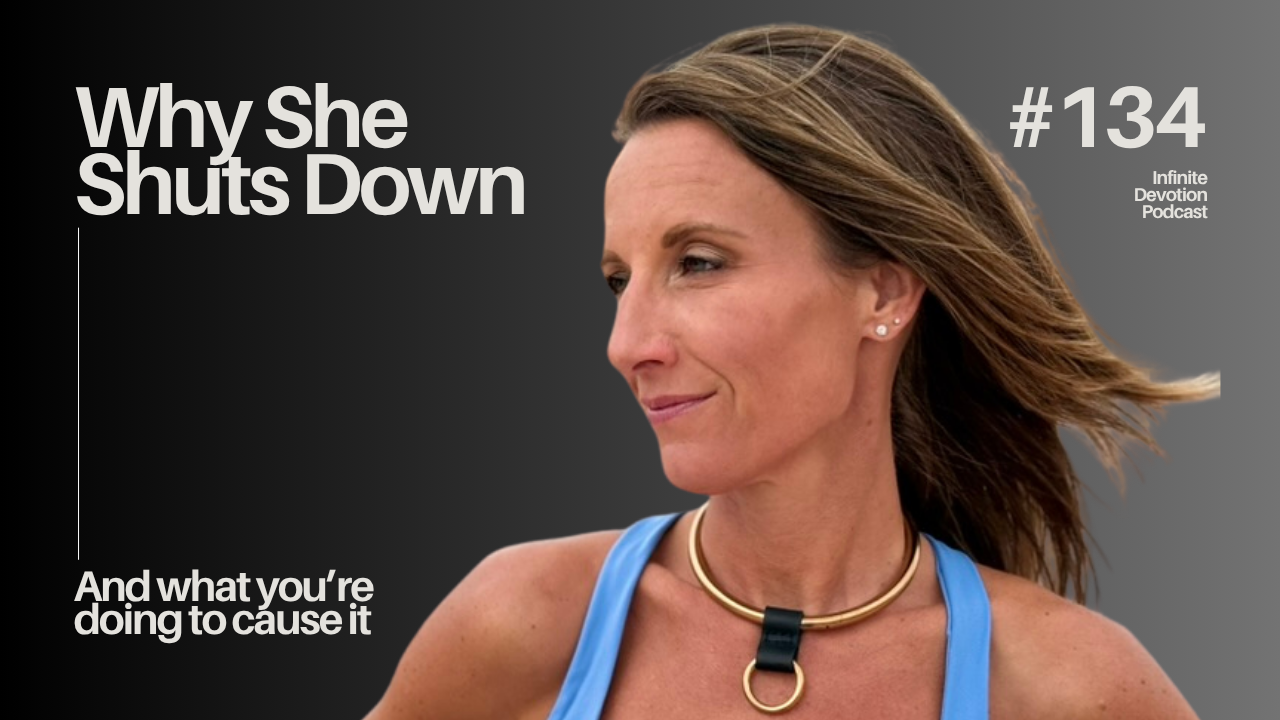
Why She Shuts Down Around You (And What You're Doing to Cause It)
Jun 01, 2026This is the full written companion to Episode 134 of the Infinite Devotion Podcast. You can listen on Apple Podcasts, Spotify, or YouTube.
I was called sensitive as a boy.
Music wrecked me in the best possible way. As a teenager, as a young man in my early twenties, I could feel things move through me when I listened to something that really got me. That felt like something sacred.
And then life set in. I got older. Things got serious. And somewhere along the way I decided that emotions were something to get past. Something to manage. Something that made me weak or irrational or out of control.
What I couldn't see then is what this post is about.
I couldn't see how much I was destroying myself through the repression. And I really couldn't see how much I was doing to Dawn through the ways I projected all of that onto her. The ways I needed her to be different so I could feel okay. The ways I told her, without ever saying it out loud, that only some of her was acceptable to me.
We had a dead bedroom. We had a conflict-avoidant, codependent relationship that neither of us wanted to honestly admit was what it was. And it took us years and a lot of painful work to understand what actually happened and how to bring it back.
This is one of the things that happened.
Emotions Are Logical. Your Logic Is Just Flawed.
If you're a man reading this, there's a good chance you think of yourself as a rational person. A logical person. Someone who solves problems, thinks clearly, leads.
That's a real thing. That capacity is genuinely valuable. There's nothing wrong with it.
But when most men apply that rational framework to emotions, they land on a conclusion that doesn't hold up under scrutiny. They decide that emotions are illogical. That they don't make sense. That the mature thing to do is to rise above them, control them, or at least not let them run the show.
Stoicism feels right, from that perspective.
I want to challenge that directly.
Every single emotion that you feel, or that she feels, or that any human being feels, is a 100% accurate response to something. Every one of them makes complete sense.
The problem isn't the emotion. The problem is the time frame you're using to evaluate it.
When you look at an emotion and decide it doesn't make sense, you're almost always doing the same thing: you're looking at what just happened in the last five minutes, or the last hour, and you're asking whether the feeling makes sense in response to that. And sometimes it doesn't. Sometimes she's upset about something that seems small. Sometimes you're feeling something that you can't trace to anything obvious.
But feelings aren't only generated by immediately preceding events.
Take that timeline all the way back. All the way back to an entire life. Because when you're willing to consider that the emotion present right now is a perfectly logical response to something somewhere much further back on that timeline... it all makes sense. Every single time.
The flaw isn't that emotions are irrational. The flaw is thinking that right now is the only relevant data point.
You Can't Logic Your Way Around Something You Won't Acknowledge
Here's where a lot of men get stuck.
They hear the argument that emotions make sense and they want to engage with it rationally. They want to understand it. And then when an emotion shows up, theirs or their partner's, they immediately want to move past the feeling and get to the understanding part.
That's not how this works.
If your partner has an emotional reaction and you're uncomfortable with it, your discomfort triggers something in you. Maybe you get defensive. Maybe you want to explain yourself. Maybe you want to fix it so it goes away as fast as possible. And the moment you're in that mode, you've lost access to what's actually happening. You can't bring logic to something you're actively trying to suppress.
You have to be able to be present with the feeling first. Accept that it's there. That it's real. That it belongs to a real human being who is having a real experience.
Because most of what we're actually saying when we tell someone their feeling doesn't make sense, or when we tell ourselves our own feeling doesn't make sense, is:
I don't like this. Make it go away.
That's the irrational stance. Not the feeling. The denial of the feeling.
You can't actually be the logical, rational one when you're in denial of what's real.
You Don't Actually Dislike Emotions
Do you dislike when she's happy? Do you disapprove of her feeling sexually turned on? Do you have a problem with her joy, her gratitude, her excitement?
You don't actually dislike emotions. You dislike some emotions. The ones that make you uncomfortable. The ones you don't know what to do with.
And notice what you do with the emotions you do like. You don't try to logic them away. You don't tell her those feelings don't make sense. You might even try to hold onto them. You might get uncomfortable when those ones go away.
So this isn't really about being rational. It's about avoiding discomfort. That's the actual thing underneath all of it.
And here's what that costs you.
The Freeway
I want you to imagine an eight-lane freeway. All eight lanes moving freely. Everything flowing.
Now imagine you step out and put a traffic cone in one lane because the traffic moving through that lane makes you uncomfortable. Anger, let's say. You don't like it when she's angry, or you don't like when you feel it yourself, so you start directing traffic away from that lane.
Then sadness. That one doesn't feel comfortable either. A few more cones. Now you're down to six lanes.
Fear. Grief. Shame. Whatever else is on your list of feelings that aren't okay.
You keep closing lanes, thinking that you can still have all the good stuff. Happy, fun, desire, passion, love... you want all of that traffic moving freely. You're just trying to reroute the stuff that makes you uncomfortable.
But you can't close off half of a major freeway and expect the other half to flow freely. What you create is a massive backup. All of that emotional energy with nowhere to go.
That's the internal state of most people. And it starts early.
What You Do to Her
When you live like this, you don't just create a backup inside yourself. You do it to her.
She starts feeling it. Maybe not consciously at first, but she feels it. She starts registering that certain feelings aren't safe to have around you. That if she brings her sadness, you'll shut down or get defensive. That if she brings her anger, you'll either match it badly or disappear. That if she brings her fear, you'll try to fix it in a way that makes her feel alone.
And so she starts monitoring herself around you. Is this okay? Is this going to push him away? Is this going to make things worse?
She starts disconnecting from her own emotional landscape in your presence. She runs every feeling through a filter before she lets herself have it around you.
And now she can't give you what you actually want from her.
Because all of it, the love, the openness, the desire, the warmth, the turned-on aliveness that you want from her, all of it runs through the same channel as the feelings you've told her aren't okay. There is no separate pipe for the good stuff. Emotional energy runs in one channel.
You're either feeling or you're not. You're either open or you're not.
When you tell her that only some of her is acceptable, you put her inside a very small room and then wonder why she doesn't fill the whole house.
Where This Comes From
This pattern of emotional repression almost never starts with a choice.
Think about the women who raised you. Your mother, your early caregivers, teachers, whoever was around in those first years.
Now ask yourself: were any of those women surrounded by a culture that accepted their emotional world? Were the men in their lives telling them it was okay to feel? Was anyone holding space for their sadness, their anger, their fear?
Almost certainly not.
The women who raised most of us were already emotionally backed up. They were raised in similar environments, by similar people, and then they grew into a world and into relationships with men who continued to tell them, implicitly or explicitly, that their feelings were too much or didn't make sense.
So they were already carrying all of that. The resentment, the disconnection from their own felt sense, the bitterness that builds when you spend years suppressing what's real inside you.
And you came into that as a boy. A very sensitive boy.
Every boy is an incredibly sensitive creature. That's just true. And as that sensitive boy, you looked to the women around you for mirroring. You wanted to know: is it okay to feel this way?
And you looked to one woman in particular, your mother, for love and acceptance. And when she wasn't happy or okay with you (because she wasn't okay inside herself) you learned how to please her and shut yourself off.
Everywhere you looked, you saw someone who wasn't okay with their own feelings. Someone who got uncomfortable when you were angry or sad or scared. Not because they were bad people. Because no one had ever told them it was okay either.
So you learned. You learned that feeling certain things gets you abandoned. Gets you in trouble. Makes you bad. Makes her uncomfortable. Makes the love less available.
And you adapted. You learned how to be something other than a feeling being.
Then you became a man and brought all of that into your relationship with the woman you love.
Care or Control?
A lot of men who live like this believe they have a big heart. They'll tell you they care deeply. And they mean it... on some level.
But caring about someone and trying to fix them are different things. Caring about someone and trying to change them so you can feel more comfortable are different things.
When you're working that hard to control the emotional landscape around you, you're not doing it for her. You're doing it for you. To protect yourself from discomfort. From being affected. From feeling something you don't know how to be with.
And somewhere deep down, even as you're doing this, there's a feeling that she doesn't love you. That she's withholding. That you're not getting what you need.
But here's what's actually happening.
She may be feeling love for you. She may feel gratitude and warmth and desire.
But you can't let it in.
Because you've closed your heart to protect yourself from the feelings you don't want, and a closed heart doesn't get to be selective. You don't get to be closed to pain and open to love. You can't receive love when you've denied the person offering it the dignity of having her own experience.
You've told her: feel the way I need you to feel, and then maybe I'll let you in.
That's not love, care, or anything of the sort.
The Transmission
This doesn't stay inside a marriage either.
If you're a father, you'll do this to your children. The sensitive boy who came to you wanting to be seen and felt something other than acceptance... he learned from men and women who also learned from men and women. This gets passed down.
The pattern continues until someone decides to change it.
And here's the thing about that: you can change it. Because you made choices, even if they didn't feel like choices at the time. You decided how to relate to your inner emotional world. You did that. Which means you can do something different.
You're not broken. You're adapted. Those adaptations made sense once. They probably protected you from something real. But you're not that boy anymore, and you don't have to keep protecting yourself the same way.
What Opening Up Actually Does
I'm not talking about becoming someone who cries at commercials and needs to process every feeling out loud. That's not the goal.
The goal is being a man who has access to his own emotional world. Who can feel what's present without needing to immediately control it or make it go away. Who can be with his partner's feelings without those feelings threatening him.
That man is more powerful, not less.
Because when you're not constantly fighting against the emotional current of your own life and your relationship, you have so much more available. You can actually see what's going on. You can lead from something real rather than from a defended position. You can feel your partner... actually feel her, what she's going through, what she needs, what's alive in her and what's stuck.
And when she feels that from you, everything changes.
She stops monitoring herself. She starts feeling safe to feel in your presence. And when she can feel all of her feelings around you, that bottleneck starts to clear. The things that have been stuck start to move. Including the desire. Including the love. Including the aliveness you've been wanting from her.
You get more of what you want when you stop blocking what makes you uncomfortable.
When was the last time you let something really move you? Music, nature, something beautiful... when did you last let yourself actually be affected by something?
That capacity is still in you. The boy who felt everything didn't disappear. He just learned to stay quiet.
Bringing him back online is one of the most important things you can do. Not just for your relationship. For yourself.
For the Women Reading This
You play a part in this too.
The emotional repression your partner carries isn't an excuse for you to suppress your own experience. If anything, the answer is the opposite. Feel what you feel. Don't hold it back because it might make him uncomfortable. His discomfort with your feelings is his work to do, and you don't help either of you by managing it for him.
At the same time, if you've been inside a dynamic where certain feelings haven't felt safe to have around him, it makes sense that you've adapted too. You've learned to keep things smaller than they actually are. You've run your own feelings through that filter.
That's not who you are. That's what you learned to do.
When safety starts to come back, let yourself feel again. Let the backlog start to move. That process can be uncomfortable for both of you, but it's the process. There's no shortcut through it.
The relationship you want, where she's open and warm and genuinely turned on and fully present with you, that relationship lives on the other side of this.
Not on the other side of her being different. On the other side of you opening your heart.
It's worth it.
This episode is part of the Infinite Devotion Podcast. New episodes every week. Listen on Apple Podcasts, Spotify, or YouTube.
If you're ready to go deeper into the work of building a relationship with real love and real desire, you can explore everything we offer at infinitedevotion.com/store.
We offer a variety of group programs, self study courses, and 1:1 coaching for individuals and couples looking for support in living healthy, loving D/s Dynamics.
Click here to learn more about the different programs and courses we have available!
Our Top 7 Tips for a Rock Solid D/s Dynamic
Free for you! Enter your name email below and we'll send it right over.
We will never sell, share, or trade your information, for any reason.
