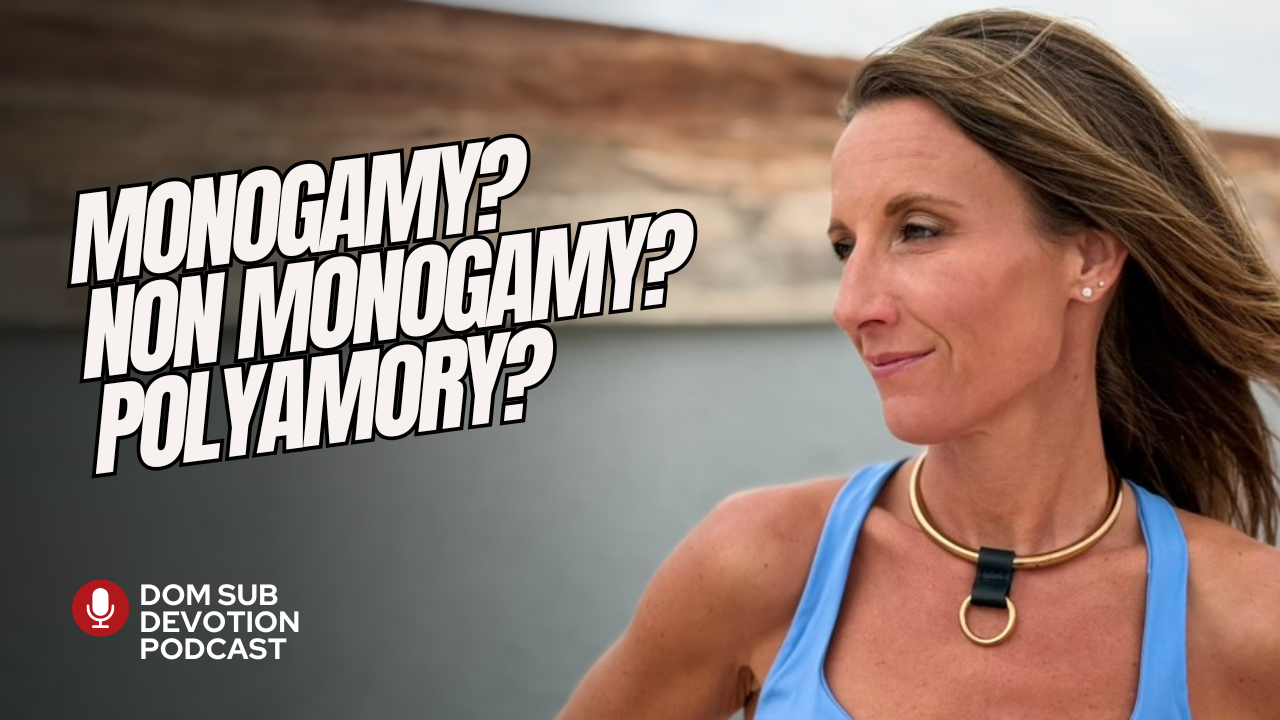
The Truth About Monogamy, Non-Monogamy, and Devotion
Apr 20, 2026This blog post goes along with episode 129 of the Dom Sub Devotion Podcast, "The Truth About Monogamy, Non-Monogamy, and Devotion.
Listen on Apple Podcasts | Spotify | Watch on YouTube
Everyone has a position on monogamy right now.
The red pill crowd says commitment is for men without options. The polyamory advocates say we were never meant to be with just one person. The traditionalists say monogamy is the only virtuous path. The ethical non-monogamy community says openness is the evolved approach. And everyone has their heels dug in hard, ready to defend their position to the death.
Ever wonder why people fight so hard to defend their stance on this?
The way I see it, most people's position on monogamy or non-monogamy isn't a philosophy. It's a defense mechanism. And until you can see that clearly, you don't actually have a choice about how you love. You just have a story you're telling yourself about why the way you're doing it is right.
The structure you're defending probably isn't protecting your freedom or your love. It's protecting you from having to feel something you haven't dealt with yet.
That's what this episode is about.
What We Actually Are
Let's start with truth, because this whole conversation usually lacks a lot of it.
Humans are not naturally monogamous creatures.
If you look at this objectively, we just aren't. We don't pair bond at puberty and stay in that one relationship for life. The evidence is everywhere, starting with how we've quietly redefined the word itself. Monogamy used to mean one partner for life. Now it means one partner at a time. That definitional shift is not evolution. It's negotiation with something we haven't been willing to look at directly.
Serial monogamy is the norm. Most people cycle through multiple committed relationships over the course of their lives. Very few people never experience desire for someone outside their partnership. The drive toward sexual and relational variety is real, it's human, and pretending otherwise doesn't make it go away. It just makes people live dishonestly.
So the traditionalist argument, the one that frames monogamy as the natural and virtuous default, is not actually grounded in what human beings are. It's grounded in what a particular cultural and religious framework decided humans should be.
But the monogamy crowd isn't the only one that misses the boat here.
The fact that humans aren't naturally monogamous does not mean that the answer is to bounce between casual connections. The argument that goes "we're not monogamous creatures, therefore we should embrace sexual freedom and non-attachment" takes one true observation and draws an entirely wrong conclusion from it. It treats depth and commitment as unnatural, as though the drive toward variety is the only drive that counts, and attachment itself is the problem.
Look at anyone who has spent an extended period living that way, cycling through casual sex and surface-level connection, and if you go deep enough with them, you'll find that it's empty too. There's a particular kind of loneliness that comes from never being fully known by anyone, and no amount of freedom or variety fills it.
Neither way actually gets us home. Forced monogamy against our nature doesn't get us there. Untethered casual relating doesn't get us there either.
Both of these arguments miss something essential, and I think it's less that they miss it and more that they're actively avoiding it. Because what they're both avoiding is the thing that makes us different from every other creature on earth: we are conscious beings. We have awareness. We have the capacity to choose something that our biology alone would never lead us to.
You can use your nature as a cage, or you can use it as a way to access your deeper self.
The bonobos from which we descend aren't choosing anything. Neither is the person who forces themselves into a monogamous commitment that's entirely about avoiding the pain of loss. The question that actually matters isn't "what are we naturally?" The question is "what are we capable of becoming, and what does that require of us?"
That reframe is where this whole conversation has to begin.
All Relationships Are a Trauma Bond
Here's the deeper truth underneath all of this, and it's one that most people are not willing to look at directly.
All relationships are a trauma bond.
Every single one. Casual sexual relationships are a trauma bond. Long-term committed partnerships are a trauma bond. The D/s dynamic that my wife Dawn and I live inside is, at its root, a trauma bond that we've chosen to go through rather than around. This isn't a pathology. It's just reality. Deep attachment activates old wounds. Every time. Without exception.
Most of what people call "relationship design" or "choosing a relationship structure" is really just people trying to architect a protection from their pain rather than actually feeling it. The person who demands strict monogamy and gets panicked when their partner so much as mentions an attractive coworker isn't making a philosophical choice about love. They're managing a terror of abandonment. The person who insists on full openness and gets uncomfortable any time their partner wants more commitment isn't making an evolved choice about freedom. They're managing a terror of being truly known by one person who could actually leave.
Until those traumas are healed, until we've done the work of becoming fully embodied in ourselves in a way that can honestly only happen through partnership, we don't actually know what we want. Everything that feels like a preference or a value or a chosen approach to love is really just a pain management strategy. It's what we think we need in order to avoid the thing we're most afraid of feeling.
You don't know if you want monogamy or polyamory or something else until you've done the work that only devoted partnership can do. Everything before that is need management. Until you've dealt with the deepest cause of that need, you only know what your fear wants. Not what your soul wants.
The Control Myth: Both Sides of It
With that foundation in place, let's look at the specific ways this plays out. Because there are mirrors here for everyone, and I want to hold them up without making anyone the villain. This isn't about shaming anyone's choices. It's about inviting you to look at what's actually driving them.
Monogamy as control
Attachment to monogamy that has nothing to do with love and everything to do with security. It's about trying to guarantee the avoidance of abandonment.
In fact, attachment in general, to anything, is always about control. It's never actually love. You can't love something, or someone, you're trying to control.
The person living this way needs their partner to be exclusively theirs not because that exclusive commitment springs from genuine devotion, but because the alternative, their partner having desires or connections that exist outside of them, is intolerable. It activates a terror of not being enough, of being left, of being replaced.
This looks like commitment. It gets labeled as virtue. It gets dressed up as values and righteousness. But underneath it is a sheer terror of being left, and that terror is running the show.
This controlling behavior requires the partner to be less than themselves. It requires them to abandon parts of their own interior life, their desires, their complexity, their full humanity, so that the fearful partner doesn't have to feel threatened. A cage can look a lot like a home if you decorate it right. But it's still a cage.
Unconscious controlled attachment makes repression and avoidance look like commitment and righteousness.
Read that again.
The result, over time, is the dead marriages and lifeless relationships we see everywhere. The seven-year itch isn't a mystery. It's just the predictable consequence of trying to force two full human beings into a structure that was never designed for their actual freedom. Seven years of being locked down, of suppressing everything inconvenient, of performing commitment while genuine desire quietly suffocates.
This also happens from the other direction. Attaching to monogamy as a way to guarantee access, to to guarantee the love and companionship and sex won't disappear. This looks like being a good partner. It looks like stability. But it's driven by the same fear. It produces obligation masquerading as love, duty masquerading as desire, and over time people start performing the relationship rather than living inside it.
Neither of these is devotion. Both of them are control. And control and love cannot coexist at any real depth.
Non-monogamy as avoidance
The people who looked at all of the above and decided the answer was non-monogamy, ENM, polyamory, relationship anarchy, or whatever other framework they're operating under are, in most cases, doing the exact same thing from the opposite direction.
Where monogamy gets used to lock love down and make it feel safe through obligation and control, non-monogamy often gets used to make sure love never gets close enough to actually hurt. It distributes attachment so thinly across multiple people that no single person ever has enough of you to really see you.
When you keep your options open, the vulnerability inherent in truly choosing one person gets to be perpetually avoided. If this relationship gets hard, there's somewhere else to go. If this person isn't giving me what I need, that person will.
The language is completely different. The values framing is different. But the mechanism is identical: using a relationship structure to manage fear rather than face it.
Distributed attachment diffuses the very pressure that would force the growth that deep intimacy and relationship makes possible. When things get genuinely hard, when the wound gets activated, when the old patterns surface, there's an escape valve. Another dynamic. Another person. The pressure releases before it can do its work, before it can burn off whatever is causing it to be so painful in the first place.
I've met people in the swinging community and the polyamory world who are genuinely having a beautiful time, who have better communication and more passion because of the openness they've created together.
I'm not here to tell them they're wrong. But in nearly every couple I've gone deep enough with where both people have opened up honestly, at least one of them is going along with the structure because they're afraid of what would happen if they said they didn't want it anymore. There's almost always one person whose participation is more about fear of losing their partner than genuine desire for the structure itself.
That fear isn't evidence that they haven't figured out non-monogamy yet. It's evidence that the structure is being used as an avoidance mechanism, and the avoidance is working.
Polyamory can be just as unconscious as monogamy. It usually is. The difference is that one uses possession and control to avoid the terror of loss, and the other uses openness to avoid the terror of being truly known by one person who could actually leave.
Same fear.
This is not an argument that either structure is wrong. It's an argument that if your relationship structure, whatever it is, is primarily in service of managing your discomfort rather than expanding your capacity to love, it isn't working. You've come up with a coping strategy that feels good, maybe even one that has real benefits. But it's still a coping strategy.
Both defended monogamy and defended non-monogamy are ways of trying to stay safe.
Conscious devotion is the thing that's actually dangerous. In the best possible way.
The Myth of the High Value Man
There's a whole ecosystem of content I can't do this episode without addressing, because it sits at the extreme end of the avoidance spectrum and it's doing real damage to real men.
The myth of the high value man, in the version I'm talking about, goes something like this: a truly high value man is so attractive, so abundant, so fully realized that he doesn't need to commit. Women should feel lucky to be in his orbit. Commitment is for men who don't have options. If you're high value enough, you can have as many sexual partners as you want, and women won't leave because they can't afford to lose you.
Before I get into what's wrong with this, let me say something about the concept of status itself: the person most concerned with status has the least of it. The moment you're trying to demonstrate your value, you've already proven you don't believe you have it. The pursuit of becoming a high value man is, by its own internal logic, low value behavior.
Now, I understand the appeal of this myth. I genuinely do. For a man who has spent years, maybe his whole life, feeling powerless around women, feeling like he was always the one who wanted more, always the one who didn't get chosen, finding a framework that promises to flip that script is intoxicating. It feels like finally having leverage. Finally having your way. It feels like freedom.
But it's just another cage.
What this myth actually is, at its core, is what happens when a man chooses to go dark to feed his neediness rather than heal the reason he was needy in the first place.
It's a decision, usually unconscious, that real love is too risky, that genuine intimacy is too exposing, that the only safe way to need something is to pretend you don't need it and take what you can get entirely on your own terms.
And here's the thing it will never deliver: love. Real love. The kind that sees you fully and chooses you. You cannot be truly loved unless you are being truly real. You cannot receive that kind of love without being seeable. And you cannot be seeable if you're performing a character whose entire purpose is to maintain leverage and control.
The men who are chasing this high value identity are usually the lowest value men in the room. Not because they're bad people, but because they've given up on love and authenticity for something that is inherently and inextricably fake. A performance for an intended, and always manipulated, outcome.
What actually makes a man high value is far simpler and far harder. It's the capacity to be fully present with one person. To go deep. To be known, really known, not the curated version, but the actual interior person, and not run from it. To choose someone and mean it every single day.
Almost any man can sleep with a lot of women. With enough access, enough surface-level confidence, and enough availability, that's not particularly rare. What is genuinely rare, what very few men can actually do, is take one person deep enough to have real love and sexual intensity with the same person, in a way that grows rather than diminishes over time. That's the hard thing. That's the valuable thing. And it requires the exact opposite of what the high value man mythology teaches.
And one more thing on this: if you actually want to be so valuable to a woman that she freely says she doesn't mind if you explore with others, if you want that to come from genuine fullness rather than fear, you don't get to claim that. She grants it. And she can only grant it authentically from a place of deep security and wholeness that the two of you have built together. If it's coming from fear of losing you, it will never feel the way you're hoping it will.
Default Monogamy vs. Conscious Devotion
Before making the positive case for devotion, there's a distinction that needs to be made clearly, because most people are missing it entirely.
Most people who are in monogamous relationships never consciously chose monogamy. They just didn't choose something else. They followed the social script. They connected with someone, felt the pull, stayed, started getting afraid of losing them, and from that point forward the "commitment" was less a choice and more a defense. A way to prevent the loss that would validate every bad belief they hold about themselves.
From the outside, default monogamy and conscious devotion look identical. Same structure. Same apparent commitment. Completely different interior.
One is chosen every day, in spite of the fear, in spite of the discomfort, as an act of deliberate presence and investment in this one person and this one relationship.
The other has a hollow center that carves people out from the inside over time into bitterness, resentment, and a quiet desperation they can barely name.
If you're in a committed relationship but you've never actually questioned why, if you've never genuinely sat with the question of why monogamy rather than something else, then what you have isn't a chosen commitment. It's a structure you're using, probably to avoid something.
The argument I'm making here isn't for monogamy as a structure. It's for devotion as a practice.
Devotion is the conscious, daily, renewable choice to go fully into this one person, this one relationship, and not let yourself off the hook. That's a completely different thing from staying because leaving feels hard or scary or would validate your worst beliefs about yourself.
Devotion as a Crucible
A crucible is a container that can hold extreme heat. It's used to melt down metal, to burn off the impurities, to get at what's actually there underneath everything that doesn't belong.
That's what a devoted partnership is. A crucible that creates the conditions for transformation of both people, a purification from their pain and trauma and fear, in a way that no defended or unconsciously chosen relationship structure can ever provide.
Here's why: you need the pressure. You need the heat. And most relationship structures, whether they're defended monogamy or distributed non-monogamy, are specifically designed to relieve that pressure before it can do its work.
Defended monogamy suppresses the heat. Everything uncomfortable gets stuffed below the surface because the attachment must be maintained at all costs. The wound gets activated, the pattern comes up, and rather than following it to its source, the couple agrees to disagree, moves on, avoids it. The heat never gets to burn anything. It just smolders underneath, producing the resentment and bitterness that eat people alive from the inside.
Distributed attachment diffuses the heat. When things get genuinely difficult, when the deepest wounds surface, when the old patterns show up and the relationship stops being comfortable, there's somewhere else to go. Another person, another dynamic, another source of what's not working here. The pressure releases. The growth never happens.
The crucible holds the heat. You stay in it. You choose to stay in it, even when everything in you wants to manage the discomfort by escaping. And over time, what burns away is the fear, the need for control, the performance, the survival strategies, the beliefs that were never actually true.
What's left is real.
Dawn and I didn't design this. We didn't sit down and decide to do the crucible. It feels far more like it chose us than we chose it. What drove it, for me, was a question I couldn't stop sitting with: how is it possible to have intense, passionate sex with the person you love most, in a way that gets better rather than worse over time? Because I refused to believe it wasn't possible.
And refusing to believe it wasn't possible meant I couldn't run away from the work required to make it real.
The D/s dynamic we live inside has been a significant part of how we've gotten here. Not because dominance and submission is the only path to devotion, but because it motivated both of us to grow, to speak up, to stop performing and start being honest, to acknowledge openly the role that power plays in love and sexual desire.
It gave us a functional container for the things that were actually true about us that most couples never find a language for. It was a path toward honesty that led us to deeper devotion.
You cannot find out who you really are in a relationship that lets you leave or numb out or escape every time it gets hard. You cannot connect to your own soul in a structure that requires both people to suppress everything that isn't comfortable. The crucible works because you stay. Not because you're trapped, but because you choose to stay in the fire and let everything burn and see what's left.
What's Actually Possible on the Other Side
What I could have never expected was what the experience of these last seven years has taught me.
On the other side of this journey together, you end up with more freedom, not less.
Real freedom. Not the performed freedom of the man who won't commit. Not the carefully curated freedom of the relationship that has locked everything uncomfortable behind a wall of obligation. Not the distributed freedom of the person who has spread their attachment so thin that no one can actually hurt them.
Real freedom, which means you actually have choices.
And just to speak to the men directly for a moment.
We're all after freedom. Whether you've accepted that, or you're still hiding yourself from it while you look at porn, sneak away to do whatever you don't want your partner or someone else to know about, or numb out on substances, video games, or mindless scrolling.
You're seeking freedom. And what I'm offering here in this essay, and in all of my work, is a path to real freedom. Not just these stolen moments. Not just these quick hits of escapism.
Actual freedom. To be all of yourself, in the wide open vulnerable presence of someone who truly loves you, and wants you, and chooses you, and accepts you, for who and what you are.
Back to the point...
If you and your partner do this work, if you actually go all the way through the unwinding of the attachment patterns and the trauma bonds and the survival strategies and the beliefs you've been carrying since childhood, then you can actually make a real choice about how you want to relate.
If you choose monogamy from that place, from a place of genuine wholeness rather than fear of loss, you've made a real choice. And even that is more expansive than monogamy by default, because it's alive. It's conscious. It's not just inertia with a ring on it.
If you choose a structure that includes more people, if you choose to open your relationship in some way, you can do that from a place of solidity and fullness rather than neediness or emptiness. The healing makes honest conversation possible. Full presence possible. Being completely yourself possible. When you're not avoiding anything in your primary relationship, the desire to explore elsewhere, if it exists, can be genuinely clean rather than a disguised escape route.
The people who chase openness and freedom before doing this work are often the least free people in the room. The men performing high value confidence are often the loneliest. The people maintaining committed relationships built on obligation and fear are often the most isolated from genuine love even while they're physically with someone every day.
The goal was never about which structure. The goal was always to become someone who actually has a choice.
And you only get there by going through something, not around it.
A Final Word
You can spend your whole life defending a relationship structure. You can make it seem virtuous, make it seem righteous, make it seem like the sophisticated or evolved or conscious or traditional or whatever label feels best to you.
Or you can actually face yourself.
You can question everything. You can be willing to blow it all up in the name of truth, in the name of finding out what's real rather than what's being acted out and performed.
Consciousness is a gift. But most people stop using it somewhere around eight or nine years old when it comes to love and attachment. We get hurt, we build beliefs about ourselves, and we spend our whole lives stuck in the patterns of how we act and how we relate and what we try to get and what we try to avoid.
We stop using our ability to see, live, and be the truth. Until we go back and deal with WHY we believe what we believe about ourselves. And that is what every one of your "relationship problems" are trying to help you do. To see where you have trapped yourself inside your own beliefs that aren't working for you anymore.
Bringing your full consciousness into partnership, into the present moment, into the willingness to feel what's actually there rather than manage it, is the work.
And it starts simply.
Choose someone.
If you're with a partner already, choose them. Choose him. Choose her. Go deep. Question all of it. Expose yourself. Get uncomfortable. Say all of the things. Be willing to blow it all up in the name of truth.
That's what love actually requires.
Listen to Episode 129 on Apple Podcasts | Spotify | Watch on YouTube
Want to go deeper? Explore Andrew's courses and coaching at infinitedevotion.com/store. If you're ready to build the foundation of real dominance, start with Becoming a Dominant Man.
We offer a variety of group programs, self study courses, and 1:1 coaching for individuals and couples looking for support in living healthy, loving D/s Dynamics.
Click here to learn more about the different programs and courses we have available!
Our Top 7 Tips for a Rock Solid D/s Dynamic
Free for you! Enter your name email below and we'll send it right over.
We will never sell, share, or trade your information, for any reason.
