How To Introduce D/s Dynamics To Your Partner
Apr 13, 2026At some point, almost everyone who wants dominance and submission in their relationship faces the same wall: how do you bring this up to a partner who doesn't know it's coming?
It's one of the most common questions we get, and it deserves a real answer. Not a surface-level "just be honest with them" answer, but a genuine look at what it actually takes to have this conversation in a way that gives it the best possible chance of going well.
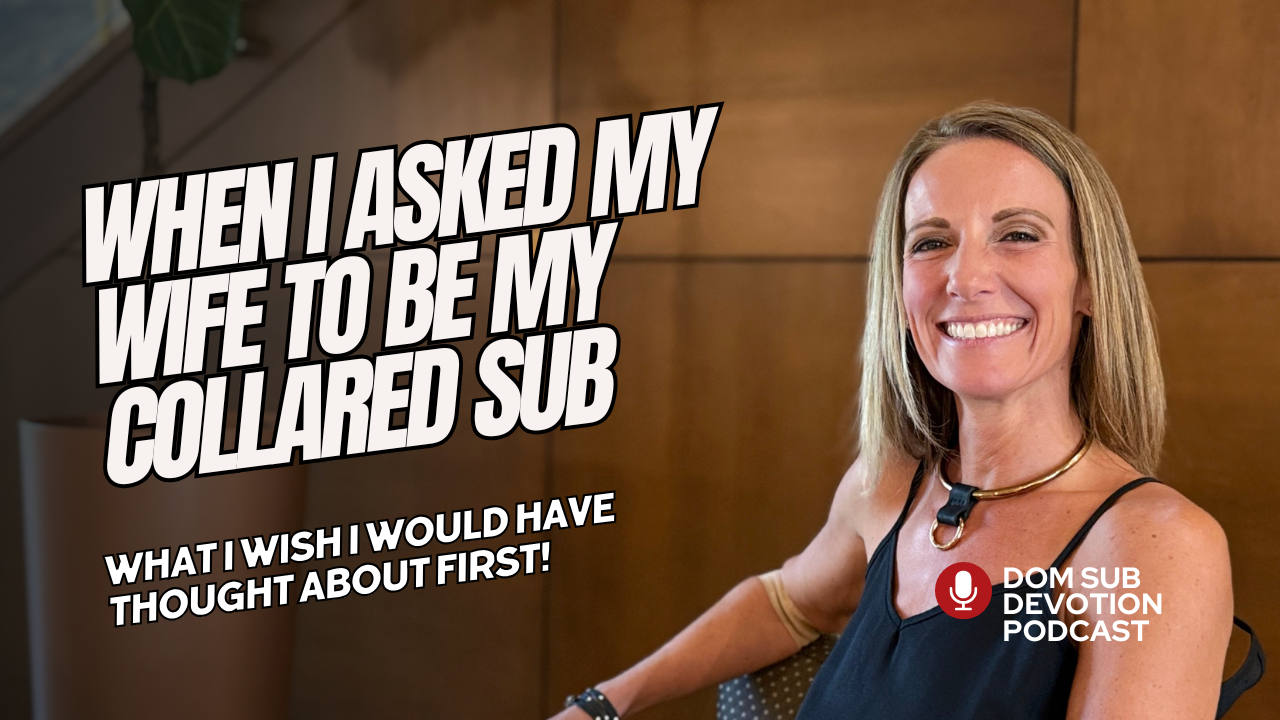
This is what episode 128 of Dom Sub Devotion covers in full. You can listen on Apple Podcasts, Spotify, or watch on YouTube. If you'd rather read, everything from the episode is here.
Before You Do Anything, Don't Do What I Did
When I brought this up to my wife Dawn back in 2018, it was somewhat on a whim. I had been working on myself seriously for several years at that point, but I had no plan for what to say after the words left my mouth. I said I want you to be my submissive, and then I had to scramble to sort out everything I hadn't prepared for.
The good news is that the scrambling taught me a lot. The bad news is that a lot of the friction that followed could have been avoided. What I'm sharing here is what I wish I'd had before that conversation.
Before the Conversation: What Both People Need to Consider
Whether you want to be the dominant or the submissive in this dynamic, the preparation before the conversation matters more than most people realize. The conversation itself, if you do this background work, ends up being far more straightforward than people expect. It's the skipping of this part that creates most of the problems.
Get clear on what you actually want
Vague desires leave too much room for fear to fill in the gaps. If you go to your partner with a half-formed idea of what you're asking for, they have no choice but to construct the meaning themselves. And the meaning they construct is going to be filtered through everything they already believe about power, control, and what words like "dominant" and "submissive" actually mean.
That could go anywhere. It could go somewhere very far from what you actually had in mind.
So before you have this conversation, spend real time getting specific. What are you asking for? What are you not asking for? What are you still uncertain about but hoping to explore? How do you see this benefiting the relationship and yourself? The more clearly you can answer those questions for yourself, the more clearly you can answer them for your partner.
Separate desire from complaint
There's a significant difference between bringing this from a place of wanting something and bringing it from a place of trying to fix something. Dominance and submission does not rescue a relationship or repair what's broken. What it can do is bring new ways of relating into a relationship that is already functioning, and give two people new approaches to communication, intimacy, and sex that they didn't have before.
But if you come to your partner with a list of problems and D/s as the solution, you are leading with blame even if you don't intend to. That framing makes it almost impossible for the other person to hear the desire underneath it.
Look at what you want and why you want it. What are the benefits to the relationship, to yourself, to your partner? Let them discover the benefit for themselves rather than trying to present it as a case you need to win.
Come from abundance, not lack
Related to separating desire from complaint is paying attention to the internal energy you're carrying into this. Are you approaching this from excitement, from wanting to bring something positive into the relationship? Or are you approaching it from a feeling that something is missing, that you're dissatisfied, that things aren't good enough?
The energy underneath the conversation will come through regardless of the words you choose. If there's blame or lack underneath it, the other person will feel that even if they can't name it. If there's genuine desire and abundance underneath it, that comes through too.
Know the difference between fantasy and reality
If what you're describing is logistically impossible given the life you're actually living, you've put your partner in an impossible position. They can't say yes to something that can't exist in reality, and they can't say no without feeling like they're failing you.
Part of the preparation is being honest about what a real, liveable dynamic looks like for the two of you. There's room for different levels of intensity. There are lower protocol times and higher protocol times. There are things that live inside the bedroom and things that extend beyond it. Getting honest about what is actually achievable, and where some desires might remain more fantasy than lived reality, at least for now, protects both of you.
Look at your history with power
This one takes courage, but it probably has more impact than anything else here.
Where did you learn about power? Where did these desires start for you? What does your family history with power look like? Where have you experienced power that was handled well, and where have you experienced power that wasn't? What are your wounds around control, around giving it up, around taking it?
Understanding your own history with power gives you clarity about why this desire is there, what it actually means to you, and what you're asking for when you ask for it. It also helps you separate the desire itself from the pain or the wounding that might be tangled up with it.
Check your urgency
If this feels like something you will explode without, if there's intense neediness around them saying yes or intense fear of them saying no, that urgency is going to come through as pressure. And pressure activates defensiveness. It puts the other person in a position where they're reacting to being pushed rather than genuinely considering what you're bringing to them.
Excitement is natural and okay. When I was waiting for Dawn to make her decision over that month, I had a lot of that building up. I had to find ways to vent it that didn't involve putting more pressure on her. A lot of journaling, a lot of writing, giving her space to consider. The urgency has to be managed before the conversation, not during it.
If You're the Man Wanting to Lead
There are some specific things worth examining if you are the one wanting to be dominant and you're bringing this to your partner.
Ask yourself honestly: do I actually want to lead?
There's a version of wanting to be dominant that is really about wanting to receive something. Obedience, service, attention, a particular kind of sex. If what you want is primarily about what you're going to get, your partner ends up being the deciding factor in whether you feel dominant. Her compliance, her giving you what you want, is what makes the dynamic work.
That puts her in charge, not you.
Real dominance is about giving first. There's plenty that gets received in a D/s dynamic, and there's nothing wrong with enjoying that. But if receiving is the point and purpose, you aren't going to put yourself in a dominant frame. You're going to put yourself in a position where you're waiting for her to create the feeling you want, which is the opposite of what you're asking for.
Ask yourself honestly whether you want to lead, which means stepping forward and giving first, or whether you are trying to get something.
Do you have the self-leadership this requires?
If you are going to ask another person to give up control of their life and follow you, you have to be able to lead yourself first. A woman cannot submit to a void. She can't surrender to someone who hasn't taken ownership of their own life. There has to be something to submit to.
Can you get your own life in line? Do you own your own shit? Is there some semblance of discipline and responsibility in how you run your work, your health, your home, your inner life?
The people who have the most success bringing this into a relationship are the ones who pause and do serious work on themselves first. That was true for me. Before I went to Dawn with this, I had spent years getting my fitness in line, taking more responsibility for my health, building discipline around my work. That self-leadership gave me the inner strength to actually lead her. Without it, the conversation would have been far worse, and the dynamic that followed would have been far shakier.
If you want a step-by-step process for this work, including the internal work, a reading list, and a framework for building the self-leadership that dominance requires, the Becoming a Dominant Man course was built specifically for this.
Be clear on what these words actually mean
When you say "I want you to be my submissive," you know what you mean. But your partner doesn't. She's going to run that phrase through her entire history, her conditioning, her fears, her associations with those words. She might hear "I want you to be a doormat." She might hear religious undertones. She might hear "I'm going to punish you and control you."
None of that might be anywhere near what you actually mean.
Part of leadership is recognizing that words mean different things to different people, and that words like these carry enormous amounts of accumulated meaning. If you're not willing to be clear and specific about what you're actually asking for, you're handing the definition over to her imagination. That rarely goes the way you want it to.
Look at your own fear and shame
If you're too embarrassed to speak clearly about what you want, that's information. You've got some shame to work through before this conversation is going to go anywhere useful.
And beyond shame, look at what you're afraid of. Are you afraid of being judged? Afraid of being rejected? Afraid of what might happen if she says yes? Fear is natural and expected. Not looking at it doesn't make it disappear. It just means it operates without your awareness.
Being honest with your own fear, and potentially being honest with your partner about it as well, is more valuable than trying to present yourself as having it all together.
Look at where you've been suppressing your dominant nature
Your partner isn't going to start feeling submissive toward you because you asked her to. She's going to start feeling it as you start actually living in your dominant nature.
You don't need her submission to feel dominant. In fact, it works more or less in the opposite direction. The more you are connected to your own dominance, before she has agreed to anything, the easier this whole conversation becomes. Because the words are being backed by something she can already feel.
Look at the places where you've been keeping the peace, softening yourself, not rocking the boat. Start stepping into those places before you bring the conversation. Give her something real to submit to before you ask her to.
If You're the Woman Wanting to Submit
There are also specific things to examine if you are the one wanting to be submissive and you're bringing this to a man you want to step into dominance.
Know where this desire is coming from
The pressure dynamic is especially intense when a submissive brings this to a dominant. When a woman tells a man she wants him to be more dominant, what he often hears, even if it isn't what she means, is "you're not good enough." Men carry a lot of sensitivity around this, and it tends to go right to the wound.
So be aware of whether you're coming from genuine desire for what you want to feel, or from dissatisfaction with how things currently are. Those are very different conversations.
Also be honest about whether there's any part of this that is about escaping yourself. If life has felt like too much, if you've had to carry everything and you want relief, that's real and it makes sense. But no dynamic and no partner can change the underlying reasons why you've been carrying everything. A D/s dynamic entered for those reasons tends to create more problems than it solves.
Do you actually trust this man to lead you?
If the trust isn't there yet, you have to be honest about that. D/s dynamics can absolutely help build real, deep, embodied trust between two people through the communication and vulnerability they require. But if you're hoping the dynamic will create trust that doesn't exist yet, the process is going to require more patience and a slower approach.
If the trust is already genuinely there, the conversation can go differently. But you have to be honest about which situation you're actually in.
Be clear on what these words mean to you
Same principle as above, applied from the other direction. When you say "I want you to be more dominant," what do you actually mean? What does submission mean to you specifically? Is it about service? Surrender? Obedience? Is it primarily sexual, or does it extend beyond the bedroom? What does it look like psychologically?
If you can't answer those questions clearly for yourself, you can't answer them for him. And if you can't answer them for him, his imagination fills the gap with whatever his history, conditioning, and fears tell him those words mean.
Look at your own fear and shame
Do you have judgment about yourself for wanting this? Negative views about submission based on past experiences with power? Fear of what he's going to think of you?
All of that is worth sitting with before the conversation. Bringing shame into it tends to undercut the honesty that the conversation needs.
Look honestly at the existing dynamic
This is maybe the most important one.
There is always a power dynamic in a relationship. What has it been in yours? If you've been the one in control, if your emotions or your moods have been setting the tone, if you've been trying to change him or manage him or get him to be different, that history matters.
If you can be honest with yourself about that, and honest with him about it in the conversation, it goes a long way. Saying "I'm asking to be your submissive, and I recognize I haven't actually been particularly submissive up to this point" is a powerful acknowledgment. It shows self-awareness. It makes room for the real conversation underneath the request.
Having the Conversation
If you've done the background work above, the conversation itself is more straightforward than most people expect. It is not a sales pitch. You are not trying to convince them of anything. You are extending an invitation to look at something together.
A few things that matter here:
Lead with desire, not complaint. Come from "I've been thinking about something I want to explore with you" rather than anything that sounds like "here's what's been wrong." The internal energy underneath the words will determine which one it actually is.
Don't have this conversation after drinking. The inhibition-lowering that comes with a couple of drinks might feel like the right time. It isn't. You need both people clear.
Don't bring it up before, during, or after sex. Find a neutral time, a connected moment, when there's no tension and no pressure from context.
Be patient with timing. Don't bring this up in the middle of an argument or when you're feeling distant. Wait for real connection and space. The timing changes the outcome.
You don't have to explain everything in one sitting. Introduce the topic. Give them room to receive it. Set it down and come back to it. Dawn took a month to make her decision. During that time I created a space in our notes app where she could write down questions as they came to her, and we'd address them when we sat down together. That gave both of us more clarity and more room than trying to resolve everything in one conversation ever would have.
Give them room to have their own reaction without trying to manage it. The initial reaction is not the final answer. If they push back or have questions or seem uncertain, that doesn't mean no. Don't walk the desire back just because they aren't immediately and fully on board.
Be vulnerable and honest about your own fear. Naming that it feels vulnerable to bring this up is itself an invitation for them to recognize you're not pressuring them. It opens the conversation rather than narrowing it.
Don't come in with everything already figured out. If you arrive with the contract drafted, the rules established, and the rituals picked out, you haven't left room for your partner to take any ownership of this for themselves. That ownership matters. This has to be real for both people.
Don't make it an ultimatum, even a subtle one. Even the internal energy of "I'm going to be dissatisfied if you say no" is going to come through as pressure. Pressure closes things down.
And don't apologize for wanting this. You don't need to. This desire isn't wrong. If you feel shame about it, that's worth sitting with before the conversation, not bringing into it as hedging or half-heartedness.
Bigger Picture Things to Hold
A few things that live beyond the conversation itself but are worth carrying into it.
Compatibility versus conversion
You cannot lead someone into wanting to submit. A submissive cannot submit their way into a dominant being who they want them to be. The dynamic amplifies what's already in the relationship. It doesn't fix what isn't working.
If there isn't genuine mutual desire here, that's a compatibility question, not a conversion project.
The submissive has to eventually hand it over
If the submissive is the one bringing this conversation, there is a transition that has to happen at some point where the dominant actually takes over the building and leading of the dynamic. If the submissive remains in control of how the dynamic is supposed to go, if they're constantly directing the dominant toward their vision of what this should look like, the dominant isn't actually dominant.
Letting go of that control is often the hardest surrender a submissive makes. But it's also the most important one. More new dynamics collapse from this than from almost anything else.
Unexpressed desire creates resentment
When desire is suppressed over time, it doesn't disappear. It turns into bitterness, distance, and a low-level disconnection that neither person can quite name. Starting to bring honest desire into a relationship often surfaces the accumulated weight of all the years it was kept down. Old resentment comes up. That's part of the process, and it has to be metabolized rather than avoided.
Both people are scared
If you are the one receiving this conversation, recognize that the person bringing it to you is probably just as scared or more scared than you are. They've been holding this, building it in their own head, carrying fear about how you'll receive it, whether you'll judge them, whether you'll accept them.
Acknowledging that both of you are navigating something vulnerable and confronting opens the conversation in a way that defensiveness never can.
Consider what you'll do if they say no
This is the one thing I genuinely wish I had done before I brought this to Dawn. I never seriously considered what would happen if she said no. I never sat with whether this relationship could have continued on a path that worked for both of us if she hadn't eventually said yes.
That's a hard question. It deserves an honest answer before the conversation, not after. If you're going to bring this, have enough respect for yourself, for your partner, and for the relationship to have thought through what you're going to do with a no. Can you let a no be a not right now? Can you continue without resentment if this isn't something they want? Can you let them say no without it becoming a judgment of either of you?
Sit with that. It's the hardest part, and it's the most important one.
The vulnerability required to even bring this conversation up is a rehearsal for what a real D/s dynamic asks of both people. The openness, the honesty, the willingness to be seen with your desire and your fear at the same time. If you can bring that to the conversation, you're already doing the thing.
This is episode 128 of Dom Sub Devotion. You can listen on Apple Podcasts, Spotify, or watch on YouTube. If this resonated, we'd love a five-star review wherever you listen. It costs you nothing and it helps this reach the people who need it.
We offer a variety of group programs, self study courses, and 1:1 coaching for individuals and couples looking for support in living healthy, loving D/s Dynamics.
Click here to learn more about the different programs and courses we have available!
Our Top 7 Tips for a Rock Solid D/s Dynamic
Free for you! Enter your name email below and we'll send it right over.
We will never sell, share, or trade your information, for any reason.
