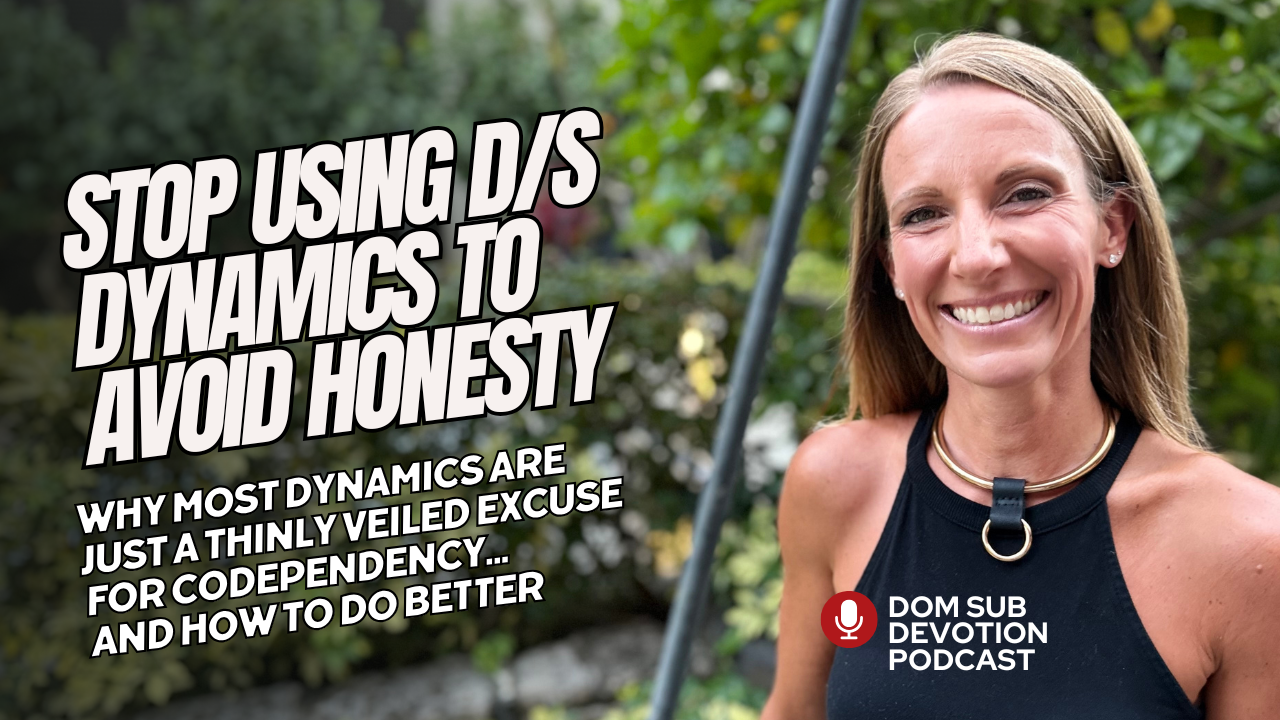
Kink or Codependency: What's really driving your D/s dynamic?
Mar 16, 2026Most people arrive at Dominance and submission carrying codependent patterns they don't even know they have. And the hard truth is that D/s doesn't dissolve those patterns. It amplifies them, because the structure of power exchange gives those patterns a very convincing disguise.
Seven years into a 24/7 D/s dynamic with my wife Dawn, I can tell you that we have had to unwind a tremendous amount of codependency from our relationship. Not because we were broken or uniquely flawed, but because codependency is simply what most of us come to intimacy carrying. It is baked into the way most of us learned to relate, to survive, to get our needs met. And Dominant submissive dynamics, as much as they can be a profound path to intimacy, can also be extraordinarily fertile soil for those codependent patterns to take root, grow stronger, and feel completely justified.
In my work as a coach and teacher, I have encountered codependency in virtually every D/s dynamic I have been close to. Every single one. Including my own. So this is not a post about judgment. It is about bringing light to places where you might think you are right, when what you are actually doing is trying to keep yourself safe.
Two Stories That Say Everything
I want to start with two couples I have worked with, because these stories make the pattern concrete.
The first couple came to me thinking they were having problems with their dynamic. As we dug into what was actually going on, what became clear was that the submissive partner was terrified. She was afraid her husband was never going to be solid enough, strong enough, Dominant enough to actually meet what she needed. And because that fear was running her, she was constantly criticizing him. Pointing out every mistake. Questioning every decision. In her mind, he was the problem. He wasn't doing enough. He needed to step up.
And yes, there were places where he had things to learn. There were places he needed to grow. But her codependent behavior was actively preventing him from being able to step forward. For an honest D/s dynamic to form between them, she had to take responsibility for the part of her fear that had nothing to do with him. The part that went way deeper than him. Way earlier than him. He was simply the place where her old patterns were playing out.
The second couple came to me because the submissive couldn't seem to let go of control. She wanted to. She craved the feeling of surrender. But she couldn't get there. The Dominant had accumulated a long list of examples: every place she wasn't submitting, every time she was questioning, every way she was getting it wrong. She had her own version of that list too. They were both blaming her, and nothing was going to change until she changed.
But here is what I saw: the Dominant had an intense codependent pattern running. His entire sense of feeling and being Dominant was placed on the other side of her submitting. Because he made her the problem, and because her behavior was the reason he couldn't feel powerful, he had actually handed her control of the relationship. His codependency had put him in a powerless position, and he was so invested in pointing out everything she was doing wrong that he couldn't even see it.
These are not unusual stories. These are the norm in D/s dynamics that are struggling. And the reason they feel so familiar is that the problem is never actually the dynamic. It is always something deeper and earlier than the relationship itself.
What Codependency Actually Is
Melody Beattie, in her foundational book Codependent No More, defines codependency as losing yourself in someone else's needs and problems. That definition carries a lot inside of it.
Codependency includes an obsessive focus on controlling or fixing the other person. A lack of clear boundaries between who you are and who they are. Losing yourself in how they are feeling. Deriving your self-worth primarily from the relationship or from how your partner treats you. Difficulty identifying and expressing your own needs. And caretaking and giving that is actually about managing your own anxiety rather than genuine generosity.
That last one is important. Codependency is not about how much you care. It is not the same thing as being a loving, giving person. It feels like caring when you are in those patterns. It feels like you are giving, like you are attentive and devoted. But what you are actually doing is giving in order to get something back. Your caring is a transaction. A strategy. An attempt to manage your own inner discomfort.
At the core, codependency is about where your sense of self lives. Does it live inside of you? Or does it live inside of another person's actions, responses, and approval? Codependency is putting everything about who you are inside of someone else. And that is the opposite of what genuine power exchange requires.
Why D/s and Codependency Look So Much Alike
Here is where it gets genuinely tricky, and why so many people in D/s dynamics don't recognize codependency when it is happening. Dominance and submission and codependency share a lot of surface-level features.
Both involve very intense focus on the other person. Both create strong emotional bonds and an intensity of feeling between two people. Both include elements of service, attentiveness, giving of yourself, and a prioritization of the relationship. Even the language overlaps. Rules. Expectations. Needs. Protocols. A codependent partner can impose rules or expectations on their partner as part of fulfilling a codependent need. A Dominant creates rules and expectations for his submissive as part of leading. Are those the same thing? Sometimes yes. Sometimes no. And that distinction is not always easy to see from the inside.
The reason it matters is this: Dominance and submission can make codependent patterns worse. Not because D/s is inherently unhealthy, but because it provides a justification for those patterns. The Dominant is supposed to lead, so the submissive's codependent need to point out every flaw in his leadership feels like she's just holding him accountable. The submissive is supposed to follow, so the Dominant's codependent need to control her inner world feels like he's just doing his job. The dynamic gives the codependency a uniform to wear.
How Codependency Shows Up for Dominants
Let me walk through some specific ways codependency masquerades as Dominance, because recognizing your own patterns is the starting point for everything.
Using your role as a Dominant to control your submissive's emotions. This is telling her what she can and cannot feel. Trying to structure or manage her inner emotional world. The only reason a Dominant would need to control her feelings is because he is uncomfortable with them. Her emotional reality is triggering something in him, and he is using his authority to try to make that discomfort go away.
Bottoming from the top. People in D/s are familiar with topping from the bottom, where the submissive tries to control the dynamic. Dominants can do the reverse. Bottoming from the top looks like using the leadership role to get inside her head, to figure out what she is feeling and when and how, so you can fix all of it and finally feel comfortable. It is leading by overgiving. Trying to use your Dominance to solve her, because if you can finally figure out how to fix her, then she will be happy, and if she is happy, you will not have to face the fact that you cannot handle it when she is not.
Using authority to change her behaviors not because those behaviors are harmful, but because they make you uncomfortable. Trying to get her to give up things she loves, abandon interests that matter to her, become a version of herself that is easier for you to manage. This is not leadership. It is a failure to accept another human being as they actually are.
Making major life decisions not from genuine leadership but from anxiety. Using the Dominant role as a way to control outcomes so that nothing can go wrong and you never have to feel the thing you are trying to avoid feeling.
Blaming her lack of surrender for why the dynamic isn't working. Putting the entire responsibility for the relationship's health on the other side of her submitting correctly. This is the clearest sign of codependency a Dominant can display, because it means his sense of self collapses the moment she doesn't feel okay, the moment she resists, the moment she's having a hard time. Those are normal human experiences. A Dominant can help lead her through them. But he cannot lead her through them if he loses himself the moment she does.
Micromanagement. This one reads as intense and committed Dominance. But micromanaging a submissive's life is usually just a way to avoid feeling something. It is control as anxiety management, not control as leadership.
How Codependency Shows Up for Submissives
The codependent patterns that show up in submission are just as common, and just as worth naming clearly.
Using submission to avoid responsibility for your own life choices and your own inner world. Handing yourself over so you don't have to face yourself.
Trying to control how your Dominant leads you. This is one of the most common struggles I see. A submissive comes in with a very clear picture of what the dynamic is supposed to look like. Her idea of submitting is for him to Dominate her in that specific way. So she controls the entire relationship to make him be the Dom she has decided she needs. She never actually experiences what surrender feels like because she is too busy managing the conditions under which it is allowed to happen. And that Dominant never gets a real chance to step into the lead, because the moment he does, her codependency will tell her he is doing it wrong.
Trying to please him in order to feel valuable. This leads a submissive to violate her own boundaries, collapse into people pleasing, do things she would not actually choose, because she is trying to derive a sense of worth from giving herself away. Service that comes from this place is not submission. It is self-abandonment dressed up as devotion.
Using submission as emotional management. Trying to escape something rather than actually feeling the freedom that comes from genuine surrender. You cannot control your way into surrender. Real submission begins where control ends.
Making yourself small. Not taking up emotional space in the relationship because you are afraid that having needs, having feelings, wanting things, might lead to you being abandoned. So you shut yourself down. You become a version of yourself that is easier to keep.
Losing all sense of a separate self. When the entirety of your identity becomes absorbed into being submissive, into belonging to someone, into being chosen, you have nothing left that is genuinely yours. And when your whole sense of existence depends on the relationship continuing, the fear of losing it becomes indistinguishable from the fear of ceasing to exist. That fear will drive you to do all manner of self-abandoning things.
Hypervigilance. Constantly scanning your Dominant's mood. Reading his face, his tone, his energy, and adjusting yourself accordingly so that he stays regulated and you can feel okay. This is one of the most concise definitions of codependency I know: you don't feel okay unless your partner feels okay.
What a Codependent Dynamic Actually Feels Like
When one or both people in a D/s dynamic are running codependent patterns, the dynamic will have a recognizable texture to it.
Neither person can tolerate the other's difficult emotions. Since human beings will always have difficult emotions, this means the dynamic is in a constant low-grade crisis. There is a relentless need for reassurance, for check-ins that go beyond practical communication, for over-explaining and over-talking, all in an effort to confirm that the relationship is okay and the other person is okay.
The energy feels extractive rather than generative. A healthy D/s dynamic has an upward spiral quality. Both people are giving and receiving in a way where each act of giving returns as much or more than what went out. When codependency is running, it feels like things are being sucked out of one or both people. There is a flatness, a depletion, a sense of being drained. Because both people are trying to extract from each other something to fill a void that was never caused by the other person in the first place.
Rules and protocols feel more like anxiety management than actual leadership. There is no room for individuality, for growth, for separate interests, for either person to be a full human being outside of the dynamic.
And perhaps most importantly, the polarity collapses. Polarity requires space. It requires some degree of individuation between two people for energy to move between them. Codependency cannot allow that space because space feels like death. When both people are fully enmeshed, when the identity of one or both people exists through the relationship rather than within themselves, you cannot have polarity. You cannot have the kind of magnetic charge between Dominant and submissive that makes power exchange feel like what it's supposed to feel like.
The Critical Difference
In a healthy, conscious Dominant submissive dynamic, both people maintain sovereignty, agency, consent, and a sense of wholeness within themselves. Both people are giving from fullness. Dominating from fullness. Submitting from fullness. Leading and following from a place of having something real to offer.
In a codependent dynamic, fear and control and pain avoidance are the actual dominant force in the relationship. One or both people are trying to complete themselves, to fill a void, through the other person's actions and behaviors. Both people are in some way empty, and both are trying to fill that emptiness with a future version of the other person who behaves differently.
And the tragedy of that arrangement is that it never works. Because the fear and the pressure and the expectation and the finger-pointing and the blame all become the baseline of what the relationship is. You never actually connect, because both people are too defended to let the other person in. The relationship spirals down rather than up, and it continues to spiral until the individuals inside of it choose to do something different.
You Cannot Give Power You Don't Have
Think about the word submit for a moment. When you click submit on a form, you are sending something. You are giving something over. For submission to mean anything, the submissive has to have a self to give. If her entire identity exists because of or inside of the relationship, she doesn't actually have anything to give. She has nothing to submit. What looks like submission is just the absence of a self, which is a very different thing.
The same is true for Dominants. You cannot lead from an empty place. When a Dominant is operating from codependency, from inner emptiness, any power he exercises will be directed toward filling that void and managing his fear. He will hurt people in the process, not necessarily intentionally, but inevitably, because his leadership is in service of his own anxiety rather than in service of her.
Real power exchange requires two people who are whole enough to have something real to exchange. A healthy D/s dynamic says: I am whole, and I choose to give you this power. I am whole, and I choose to lead you. Codependency says: I am going to control you so that you don't make me feel what I am afraid to feel. Or: please take control so that I don't have to face myself.
Vulnerability and neediness are not the same thing. Power exchange is deeply vulnerable, and both Dominant and submissive have to be able to be genuinely vulnerable for real exchange to happen. But vulnerability comes from strength, from enough inner groundedness to let someone in. Neediness comes from emptiness. One opens the connection. The other closes it.
Your Relationship Problems Are Not Relationship Problems
Your relationship problems have nothing to do with the relationship. The way two people relate to each other is a direct expression of how those two individuals are feeling inside of themselves, and the ways they are trying to get from each other, control each other, extract from each other, escape themselves through each other. The relationship is not broken. The relationship is exactly what it is because two specific individuals with specific histories brought themselves into it.
The individual pain that causes codependent patterns almost always traces back to things that happened before the age of about eight. Those patterns were formed as survival strategies in an environment where a child did not have the resources to process what was happening. Those strategies made sense then. They do not serve the same function in an adult relationship, but they run because they were never resolved at the source.
Which means that neither you nor your partner is the cause of what is happening in the dynamic. You are both the place where older patterns are playing out. And you cannot fix that by fixing the relationship. You can only address it by doing individual internal work.
What Differentiation Actually Means
There is a concept in the work on codependency called differentiation. It means being able to maintain your sense of self while in intimate contact with another person. Staying fully present in the relationship while remaining a distinct individual within it.
Differentiation is the foundation that makes real power exchange possible. Two people who can be whole within themselves and then choose to remain in relationship, choose to lead, choose to follow, choose to exchange power from a genuine desire to give rather than a desperate need to get, that is what an actual D/s dynamic is built on.
Building differentiation requires being able to spend time apart without it feeling like the relationship is collapsing. It requires being able to state clearly what you want without having to manipulate or control the conditions to guarantee you get it. It requires understanding that your partner's emotions are not your responsibility to manage. You cannot control another person's inner experience no matter how hard you try, and the belief that you can or should is at the heart of codependency.
And critically: you do not have to leave the relationship to develop differentiation. Many people reach a point where they feel they cannot be themselves inside their relationship, and they decide they need to leave in order to find themselves. But leaving a relationship because you cannot be yourself inside of it is blaming the relationship for a problem that lives inside of you. You can find yourself within the relationship. Choosing to stay while both people do this work is, in my experience, one of the most intimate and profound things two people can do together.
The Work That Actually Moves the Needle
Coming out of codependency and into genuine power exchange is individual work. It has to happen in you first. The modalities I point people toward most often include EMDR, hypnotherapy, somatic experiencing, and Internal Family Systems therapy. Each of these approaches the problem from the level where it actually lives, which is the body and the nervous system, not just the thinking mind. Codependency is not a belief problem you can think your way out of. It is a felt experience of threat and survival that has to be addressed in the places where it is stored.
Working with a coach who understands these dynamics can accelerate the process significantly. Journaling practice. Codependents Anonymous, which is a real thing and worth knowing about. Any consistent practice that builds your capacity to sit with your own discomfort without using your partner or your dynamic or the relationship to escape it.
Redeveloping your individual identity matters too. Before you were in a codependent relationship, did you have hobbies you abandoned? Goals and desires and things you wanted to do just for you? You are allowed to be an individual and still be in a relationship. More than allowed: that individuality is actually a prerequisite for the polarity and power exchange that D/s at its best creates.
And critically: you do this work regardless of what your partner does or doesn't do, on their own timeline. You cannot fix them. You cannot control when or whether they do their own work. You focus on you. That is both the hardest and the most productive thing you can do for your relationship.
What Becomes Possible on the Other Side
Dawn and I have stood face to face through a tremendous amount of this work. We have stayed, even when staying was hard. And what has become possible because of that commitment is a level of intimacy in our power exchange that I could not have described to you when we started. I am still not sure I can fully describe it now.
When two people have built a real sense of themselves as individuals, and then they choose to remain in relationship with each other, and they choose to exchange power from a place of pure authentic desire, something real becomes possible. Something that most people in D/s dynamics are still searching for. Not because they don't want it badly enough, but because they are trying to build it on a foundation that cannot hold it.
You have to be complete to submit. You have to be complete to lead. When both people bring that completeness into the dynamic, they have something real to give rather than something they are desperately trying to get. And that is the difference between kink as costume and D/s as a genuine path to intimacy.
The Question to Sit With
Are you in some way trying to lose yourself in your partner? Trying to get something from them? Or are you choosing to give yourself to them?
There is a universe of difference between those two things. And the work of knowing which one is actually driving you is some of the most important work you will ever do.
We offer a variety of group programs, self study courses, and 1:1 coaching for individuals and couples looking for support in living healthy, loving D/s Dynamics.
Click here to learn more about the different programs and courses we have available!
Our Top 7 Tips for a Rock Solid D/s Dynamic
Free for you! Enter your name email below and we'll send it right over.
We will never sell, share, or trade your information, for any reason.
