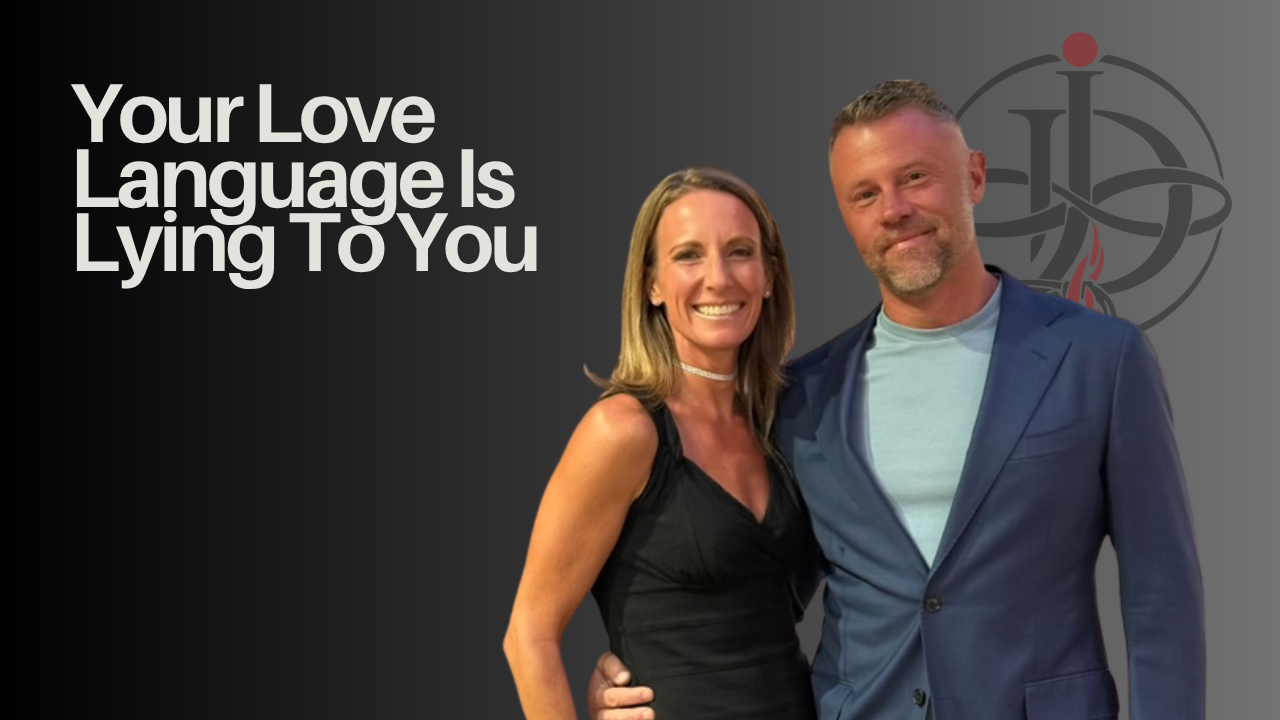
Why I No Longer Have a Love Language (It Was Lying to Me)
Sep 21, 2026Everyone knows their love language. Couples quiz each other on it over dinner. Therapists assign the book as homework. Knowing whether you are words of affirmation or physical touch or acts of service gets treated as the starting point of relational wisdom, the first real vocabulary most of us are ever handed for love.
Mine was words of affirmation. When I first took the quiz and read the description, I about blew my top. Finally. Finally I had a way to explain to Dawn what I needed more of to feel loved.
Your love language is real, and it is telling you something true. It is just not telling you what you think it is telling you.
That is what this post is about. It comes from episode 150 of the Infinite Devotion podcast, and if you would rather listen than read, you can find it on Apple Podcasts, Spotify, or YouTube.
What Chapman Got Right
The framework starts with an accurate observation. People register care differently. One person melts at a clean kitchen. Another melts at a hand resting on the back of their neck. Another at a gift, or an evening of undivided attention, or the words "I am so proud of you."
That observation is real. Gary Chapman noticed something true about human beings.
The trouble starts with the prescription built on top of it. The prescription says: hand your partner the manual for you. Tell them what feels like love to you. Learn what feels like love to them. Speak each other's languages consistently, and love will flow in your relationship again.
I followed that prescription for years. I want to show you what it actually produced in my marriage, and what your love language has been trying to tell you the whole time.
The Map Underneath
Your love language is a precise map of where your neediness lives. It names the exact spot where your okayness depends on your partner's behavior. The place where, if circumstances are right, you feel loved. Which means it also defines, for you, exactly when your partner is not loving you correctly.
These days, when someone tells me "that's my love language," what I hear is where their self-abandonment lives. Listen to what each one actually confesses.
Words of affirmation says: I need your words to validate me, to show me you believe I am enough, because somewhere along the way I concluded that I am not.
Physical touch says: I need your contact to feel wanted, safe, desired. Without your touch, I do not feel wanted.
Acts of service says: I need to see you doing things. Your actions have to prove to me that you care.
Quality time says: I need your attention on me to feel like I matter.
Gifts says: I need evidence that you were thinking of me when I was not there.
These are sketches, and each one plays out in a hundred variations. But every one of them says the same thing to your partner: behave this way so that my particular emptiness feels filled up.
Where the Emptiness Comes From
If your love language felt like a revelation when you first found it, like someone finally put words to something you had never been able to speak, there is a reason. That was my experience exactly. The question worth asking is why that ache was there in the first place.
As children, we need love. Not as a preference, as survival. Our parents and caregivers are the people keeping us alive. And every single one of us, in some way, at some point, concluded that we had to stop being ourselves in order to keep that love flowing.
Picture it. A parent comes home from a brutal day, headache pounding, and boisterous little you comes bounding into the room, thrilled about something. You get told to quiet down. Go sit down. And you conclude that this is about you. Because that is the only conclusion available to a child. A child's world revolves around themselves, and a child has no capacity to understand that mom or dad had a bad day, that the storm has nothing to do with them. So the child decides something. I am too much. I am bad. Something is wrong with me. And then the child adjusts who they are so it does not happen again.
Every one of us did some version of this. Sometimes in small moments like that one. Sometimes in response to genuinely traumatic things. Either way, the wound is the same shape, because the wound was never really about what happened to us. It was about what we decided it meant about us.
That act of self-abandonment tears a hole in the middle of us that has ached to be filled ever since.
For me, the decision was: I am bad. There is something wrong with me. Nobody really loves me. That was my void. My parents did not put it there. The people who hurt me did not put it there. I put it there, with the only mind I had at the time, a child's mind, making meaning out of things a child cannot understand.
And then we grow up, and we never once reconsider the decision.
Love on the Take
So we enter adulthood carrying this emptiness, and we start relating. First crushes, first relationships, first loves. And without ever saying it out loud, we hand our partners a job: fill this.
Love me so I can feel worthy. Want me so I can feel like I am enough. Be steady so I can feel safe.
That is love on the take. And here is what makes it a tragedy rather than just a strategy that fails: you are love. At your core, underneath every decision you made about yourself as a child, you are love itself. Love is something you are, not something you acquire. But you cannot feel that truth while the hole is still open. The emptiness blocks the view.
The love language framework caters to this emptiness without ever naming it. It hands the void a vocabulary. Your ache finally gets to explain itself in five tidy categories. But a vocabulary does not change the emptiness. It just makes the demand more articulate.
Because when you exchange love languages with your partner, what you are actually doing is trading manuals for filling each other's emptiness. And I will grant this: in the moments when it works, it feels like intimacy. It feels like love.
But if you have ever found lasting peace and contentment because your partner spoke your love language consistently enough, please write to me. I have never met anyone who has. Not one person, and I have been in this work a long time.
What the exchange produces in practice is scorekeeping. I told you what I need and you still do not do it. You do not do it enough. I need more. The love language becomes a standing invoice. They have to keep paying and paying, and yours becomes the same for them. And on the day one of you is sick, or knocked flat by life, and has nothing to give, the other one now has precise language for exactly what they did not receive. Love stops being something given freely and becomes a service agreement.
Two empty people trying to pour something into each other out of the nothingness they feel inside can never work. Even when both people comply perfectly, nobody ever feels full. Tomorrow comes and you need more. There is no end to it, no contentment, no peace, because you are trying to source your fulfillment from outside yourself, and the void cannot be filled from the outside. Your partner did not make it. They did not decide you were unlovable. You did. And what you tore open, only you can mend.
Why the Love Never Lands
There is a second mechanism here, and it is the one that took me the longest to see.
To get Dawn to give me those words of affirmation, I was constantly calculating. How do I need to show up? Who do I need to be? What do I need to do so she will say the things I need to hear? Which means I was not being me. I was being a curated version of me, a performance engineered to extract validation.
So when she gave me the words, who was she loving? Not me. She never got the chance. She was loving the performance, because the performance was all I let her see.
Love from outside, when you are still empty inside, only ever lands on the performance. It cannot reach the person underneath, because the person underneath is buried below the very emptiness the performance was built to cover.
Dawn loved me like crazy. I loved her like crazy. And we would not let each other feel it. She had all kinds of love for me and I could not feel it. I had all kinds of love for her and she could not feel it. This is the tragedy of love languages: the framework tells you exactly how to pour love into the emptiness, and the love never touches the bottom.
Three Tests You Can Run
You can check all of this against your own experience right now.
First test. Notice what happens in your body when your partner speaks your love language. Is it joy? Is it peace? Or is it relief? Be honest. Relief means an ache got temporarily quieted. And you know it never truly landed if the same ache is back tomorrow asking to be quieted again. That is a bucket of water on a forest fire.
Second test. What happens if they stop? What if the words stop coming, the touch stops, the quality time dries up? What if something happened that made it physically impossible for them to love you in your language? If the honest answer is sadness, resentment, anxiety, or a quiet consideration of whether you would even stay, then it was never a preference. It is a demand. It is an expectation wearing the costume of self-knowledge.
Third test, and this one caught me. When you first discovered love languages, what excited you more? That you were finally going to learn how to love your partner better? Or that they were finally going to understand how to love you? I know my answer. I ran to Dawn with the book because she was finally going to get it.
What It Looked Like in My Marriage
I read somewhere, and I wish I remembered who said it: "I could survive for weeks on a good compliment." That is a words of affirmation person, guaranteed. That was me.
Here is how it actually played out, and I am only going to speak to my side of it. Dawn can share hers on a future episode if you send in questions for her.
Dawn has had a survival pattern of shutting down. When life got heavy, she would pull back into what we now jokingly call getting stuff done mode: working out, cooking, moving through the day with the emotional connection switched off. Off from life, which meant off from me.
So she would be in that pattern, just doing life. And I would start counting. She knows words of affirmation matter to me. She has not said a single kind thing in days. It feels like weeks. The pressure would build and build, and eventually I would collapse into a needy mess. I would break down and tell her, "I do not know what else I can say to get through to you how much I need this. It feels like you do not even care."
This is not flattering to admit. I am telling you anyway, because you need to see what the pattern actually looks like from inside.
And what did my collapse produce in her? She felt like a failure. Like she was not good enough. Like she never did it right. Those were the exact sentences she had written about herself in her own childhood, her own void-making decisions, and my neediness pressed on every one of them. She would start to wonder if I was going to leave.
All I thought I was saying was: I need more of this. All she could hear was: you are failing.
And here is the brutal part. She was right. It never was going to be enough. There was no quantity of words of affirmation that would ever leave me full. If she gave me enough today, tomorrow I would need more. Keep telling me you love me. Keep telling me I am good enough. Keep going, keep going, keep going. How could she ever feel like she succeeded? The task I handed her was impossible. You cannot give enough to fill up emptiness.
Her body read the neediness inside every request. That is the thing about a love language spoken on demand or under expectation: the same act can be a gift or it can be a get, and what determines which one it is lives inside the person receiving it. A get is neediness being serviced. An invoice presented daily, that your partner has to keep paying just to keep the peace.
That is not love. That is emptiness showing up in the relationship expecting someone else to make you feel like enough.
The Only Thing Shaped Like the Hole
Everything comes back to inner child work, and here is why.
The void was made by a decision you made about yourself, in specific moments, at a specific age. So the void gets filled the same way it was made: by you, in those moments. I had to go back into the times when I decided I was not okay, not lovable, not good. Back to the boy screaming into his pillow at six years old. And I had to give that boy what he did not have then: someone who cared enough to sit with him, to give him a voice, to reassure him.
What I actually needed, it turns out, was to speak words of affirmation into myself. At the exact spot where I abandoned myself.
Love poured by you into you, at the exact site of the original abandonment, is the only substance shaped like the hole. That is the square peg for the square hole. Your partner's love aimed at your emptiness is a square peg in a round hole. It cannot fit, no matter how skillfully they speak your language, because they did not make the hole and they cannot reach it.
The more I went back, the more time I spent with that boy, the more peace I found with what happened and what I had decided it meant, the more of myself I could bring back together. The buried part filled with my own love.
And I needed less and less from Dawn.
The Other Side
Today I would not say words of affirmation is my love language. I would say I do not have one.
I am love. I know that about myself now, because I have loved myself thoroughly enough to prove it.
That does not mean I want nothing. Just the other day, Dawn told me how grateful she is for the attention I put into taking care of her, and that even though she does not say it every day, none of it gets taken for granted. It felt wonderful. But notice what changed. I am not on the take anymore. I am not sitting there with a meter running, needing more. So when she shares something real, it is enough. It lands on a version of me that does not need her to say it, which is exactly why I can feel it all the way through. I am okay whether she says it or not. So when she does, it is purely a delight.
And this is the real turn, for anyone still with me. Only when I stopped needing those words from her could I actually give love to her without strings. No hooks, no bill attached, nothing I am trying to get back. Love stopped being a transaction and became overflow. When you have filled your own emptiness with the love only you can give yourself, you have so much that you can give and give and never run dry, even on days when nothing comes back.
Love languages do not disappear on the other side. Honestly, Dawn and I give each other more of what those categories describe than we ever did before, by a long shot. Knowing how she loves to be loved is beautiful intelligence that I get to have and use freely. The difference is that there is no neediness underneath it anymore. No too much, not enough running under the surface. No question of whether saying yes today creates an obligation for tomorrow. The acts are the same. The invoice behind them is gone.
Use It as a Diagnosis
So here is what I want you to do with your love language.
Next time you are about to tell your partner what you need more of, next time the wanting rises up and it feels like it is never enough, trace it back. Look inside yourself instead of at them.
When did you first feel like you needed someone else to tell you that you were good enough? When did you first need someone's touch, or attention, or effort, or gifts, to feel like anyone cared? What is the earliest moment you can remember? When did you decide you could not feel that on your own?
Your love language hands you the address of exactly where you need to go love yourself. Stop using it as a weapon to get something from your partner, and start using it as a diagnosis. Seen this way, it becomes one of the most useful things you can know about yourself.
Because imagine a love where you show up full and your partner shows up full and nobody needs anything from each other. Everything given is a gift. Everything received is a delight. That is the whole game. And it starts with what you do with your own emptiness, not with what you can get your partner to say or do.
That is what love languages can really be.
Listen to the Episode
This post goes with episode 150 of the Infinite Devotion podcast. You can listen on Apple Podcasts, Spotify, or watch on YouTube, and you can find every episode at the podcast hub.
If this raised questions for you, send them through the contact page at infinitedevotion.com and I will answer them on a future Q&A episode. And if the work we do here has been valuable to you, a five star review on Apple, Spotify, or YouTube takes fifteen seconds and helps this reach more people. It is the only thing I will ever ask of you.
You will find more free tools on our free resources page, and the rest of the blog goes deeper on everything touched here.
The ache your love language describes is real. It has been telling you the truth your whole life. It was just pointing inward the entire time. Go find the moment it started, sit down next to the kid who decided it, and give them what they have been waiting for. Everything else follows from that.
We offer a variety of group programs, self study courses, and 1:1 coaching for individuals and couples looking for support in living healthy, loving D/s Dynamics.
Click here to learn more about the different programs and courses we have available!
Our Top 7 Tips for a Rock Solid D/s Dynamic
Free for you! Enter your name email below and we'll send it right over.
We will never sell, share, or trade your information, for any reason.
