Marriage Is Dead, Long Live Marriage
Nov 10, 2026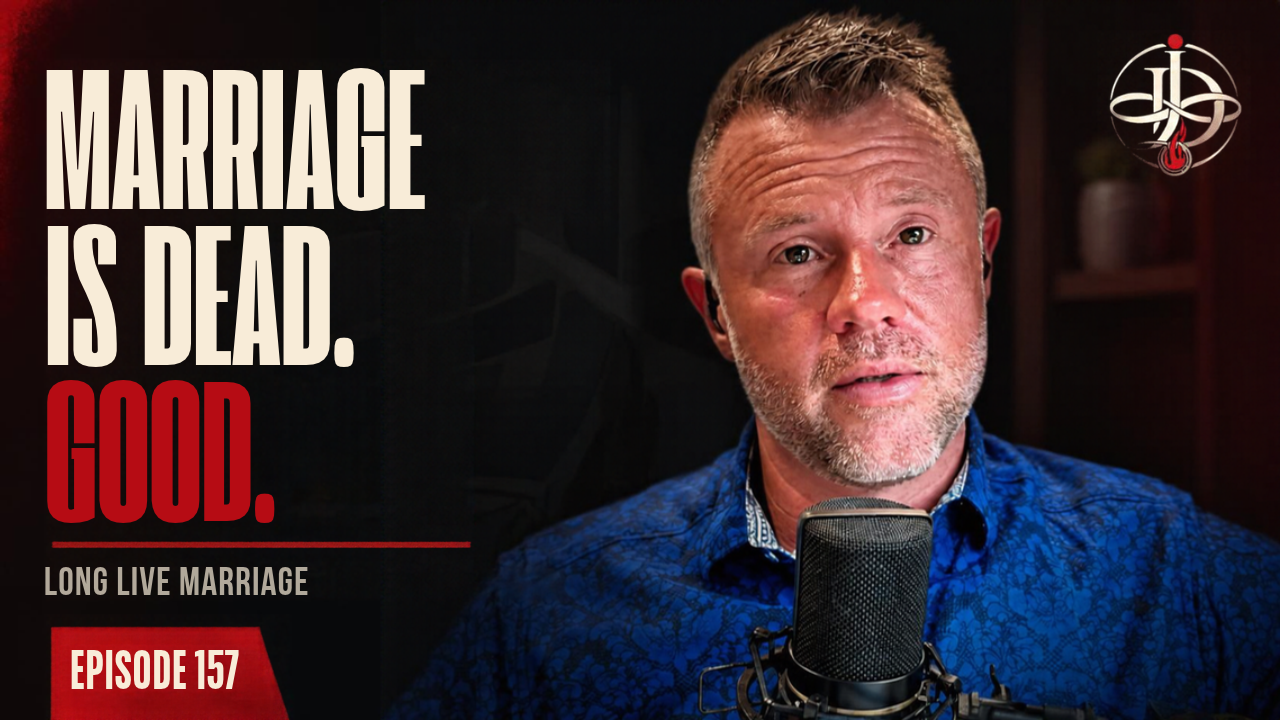
This post goes with Episode 157 of the Infinite Devotion Podcast. Listen to the episode here.
In short
Passion fades in a long marriage because two people slowly go into hiding from each other, not because of time or familiarity. The real self that showed up at the beginning gets replaced by an acceptable version built to keep love from leaving, and acceptable people can run a household together but they can't burn. The way back is for each person to come home to themselves, next to someone who has promised to stay, and when that happens the desire you had at the beginning returns on its own. That is the new purpose of marriage, and it's the subject of my book, Infinite Devotion: How Love and Desire Grow Together for a Lifetime.
Marriage is dead.
I mean that as plainly as I can say it. The thing our grandparents entered, the thing our parents entered, the thing most of us walked into in our twenties without ever asking what it was for. That institution is dead. And I'm glad. Most of what died deserved to.
I know that's a strange thing to read coming from me. I've been with my wife, Dawn, for seventeen years, and I've spent the last several of them talking and writing about love and desire and marriage. If anybody should be defending the institution, it seems like it should be me.
But I'm writing this for one person in particular. You love the person you're with. You'd never want to lose them. And the passion is gone. The wanting, the heat, the sex that used to feel like it could burn the house down. Somewhere along the way it went quiet, and everyone around you says that's normal.
So stay with me. I'm going to bury the old marriage first, because the old marriage is the reason you were told to settle for that. Then I'm going to hand marriage back to you with a new job. You can have deep love and intense passion with the same person, and it can keep getting better, hotter and deeper for the rest of your life. You didn't have to force it at the beginning, and you can't force it now.
One thing before I start. When I say marriage, I mean the vow. Two people who have decided, on purpose, with their eyes open, that they're in this for life. I don't care whether there's a license in a drawer.
In order for marriage to be reclaimed, the old versions of it have to die. So let's kill them.
What was marriage for, and why is it dying?
Start with a question almost nobody asks. What is marriage for? Why do we assume, from early in life, that we're all destined to end up in one?
For most of human history, almost nobody would have answered love. Love was nice if it showed up. Marriage was an arrangement, and it had jobs to do.
It kept people alive. One person alone could not make it through a winter. You needed two sets of hands and the families behind them. Today one person with a job can feed and house themselves and have dinner from any restaurant in town dropped at the door in twenty minutes.
It settled property. Who owns the land, who gets it when I die, whose children are whose. We have courts and wills and DNA tests for that now.
It was a woman's entire economy. For most of history she couldn't own property or sign a contract. In this country, a woman couldn't count on getting a credit card in her own name until 1974. Getting married was how she ate, and leaving was barely an option, and everyone in the house knew it. Now she earns her own money and signs her own lease. Of everything on this list, that's the one I'm happiest to see gone, because a woman who stays today is staying because she wants to. A woman who doesn't have a choice can only choose obligation.
It was the only approved place for sex and children. Birth control changed that inside of one generation, and most of the shame went with it.
It gave you standing. A respectable adult was a married adult, and an unmarried thirty-year-old started to look like a problem to the family. Today you can be forty and single and nobody thinks twice. Your mom or your grandma might give you some crap, and that's about it.
And for a lot of people, it was a promise to a religion. For some, that still holds everything up. For many more, it stopped holding a long time ago.
Every job marriage ever had got turned on its head and made irrelevant in a couple of generations. Every tenant moved out of the building, and the lights are still on. We still hold the ceremony, buy the dress and the tuxedo, walk two people down the aisle. And they're joining an institution that only matters anymore because of tradition.
You can see it in the numbers. In 1960, about 72 percent of American adults were married. Today it's right around half. In 1980, 6 percent of forty-year-olds had never been married. By 2021 it was one in four.
People call that a moral collapse. Selfish kids, scared of commitment. I don't buy it. When an institution loses every reason it existed, people stop showing up to it. That's what's supposed to happen.
And don't read any of this as a man who wants to go back. The people preaching a return to traditional marriage are yearning for a time that doesn't exist anymore. I don't want one piece of the old thing back. A marriage people stay in because they can't afford to leave, or because their religion told them they'd go to hell if they didn't, isn't a marriage. It's a hostage situation. A lot of our grandparents' marriages were two people who couldn't stand each other and either had nowhere else to go or were afraid to walk away. The end of that is a liberation.
That version of marriage is dead. Good riddance.
Why does marrying for love fail too?
So when the old version stopped working and we kept the tradition going anyway, what did we put in the empty building?
We put in love. Or what we thought was love. We made marriage about how we feel about each other.
That sounds like progress, and in some ways it was. But look at how it works. If I'm married to Dawn because of how she makes me feel, then everything rides on what she does and what she doesn't do. She does the things I like, I feel good, and I feel love toward her. She does something I don't like, I feel bad, and now we have a problem.
That leaves no space for her to be herself. It leaves no space for me to be myself either, if I have to perform whatever pleases her. A marriage built on how we make each other feel only has room for two people trying to please each other. So we end up with two people asking each other to abandon themselves, and we call that love.
Nobody can keep that up for a lifetime, and nobody stays turned on inside it. So the feeling fades. And when it fades, we fall back on an assumption.
You know the assumption. You've heard it your whole life. Passion belongs to the beginning. The honeymoon phase ends. After that, if you're mature, you settle into being partners. If you're lucky, best friends. A good team. And if you're lying awake at night longing for the intensity you felt at the beginning, you get told to grow up, because this is what real love looks like.
The experts sign off on it. Take a dead bedroom to a counselor and you'll be told to schedule sex and plan a date night. Well, who's going on the date? Two people who've lost the passion, sitting across a restaurant table under the pressure of trying to feel something neither of them feels. I have never met one person whose wanting for another person showed back up because it was on the calendar. If you've met one, send them my way.
Nobody actually wanted this deal. None of us signed off on the idea that a relationship starts hot and fades into comfort. We just assumed it was the only option, and then we gave that assumption the power to define what a long relationship looks like.
And a generation of kids grew up watching it. Two people running a household. Some affection, in the better homes. Heat, almost never. Hardly anyone grew up in a house with two parents who still felt passion for each other, so we have no reference point for it. Other kids watched a divorce, or several, or a cold war that lasted thirty years.
Those kids are grown now. And when one of them looks at marriage and says, why would I sign up for that, I think that's a completely sane response. If the only thing on offer is what they watched, then no is the right answer. If I hadn't been so steeped in the tradition, I'd probably have said no too.
Our dead bedroom years
I know what they watched, because our marriage played out exactly that way.
About twelve years ago, if you'd looked at my life from the outside, you'd have thought I had it all. I've called it being the king of the suburbs. The big house. A successful business and plenty of money. A good reputation, and friends with influence. A wife I loved, and we were friendly with each other. We liked each other.
Just a few years before that, when the relationship was new, Dawn would hear the door open when I got home and come running to meet me. There was so much heat between us that we had clothes we had to throw away, because we'd torn them off each other. We couldn't get to each other's bodies fast enough. We broke a bed. It collapsed underneath us.
That was where we started.
A few years in, I'd walk through my own front door and she wouldn't turn around. I'd stand there with my keys in my hand, scanning her mood, scanning the room, trying to work out who I needed to be that night to earn a couple of scraps of affection. Our sex life went from breaking a bed to something that resembled sex every month or two. And when it happened, she wasn't into it, and I knew it. In a lot of ways that was worse than going without.
So one night I lay in bed next to her and argued my case. I had it outlined, point by point. Why she should want me. Everything I'd done for her and for her kids, everything I provided. I don't just want obligation sex, I told her. I want you to want me.
About halfway through, I saw myself. A grown man, somewhere around thirty-five, in the dark, trying to convince his wife to feel something she didn't feel. As if anyone has ever once negotiated their way into authentic desire.
And we still loved each other. That never left. The love was there. The fire was gone. And Dawn's assumption was that this was just what happens, that I was being immature, expecting something impossible.
So that version of marriage, the one that starts hot and fades into comfort, is dying too, right behind the first one. Marriage as an arrangement is dead. Marriage as a feeling you try to hold onto is dying in front of us. And most people look at those two and decide that's all there ever was, and that the only remaining option is for the whole institution to go away.
I couldn't accept that. I didn't want to live in a world where I couldn't have the best sex of my life with the person I loved most, and have it get better as we grew deeper in love over the decades. I wanted both. I wanted to love my wife deeply and want her badly, and I wanted her to love me deeply and want me badly, for the rest of my life, in a way that got better with time. I refused to believe I had to pick one.
So I said no. And I set out to prove it was possible.
That no left me with a question. If marriage isn't needed for survival anymore, and holding onto a feeling can't keep it alive, then what could marriage be for?
What is marriage for now?
You can have both.
Deep love and intense passion, with the same person, in the same marriage. And it can keep getting better for the rest of your life. That is what the new marriage is for.
My book, Infinite Devotion, is out now. It walks you through everything Dawn and I went through to make that true. You can get it at infinitedevotion.com/book.
The first marriage was built to keep people alive. The second was built on holding onto a feeling. This one is built for love and desire to grow together for a lifetime. The old versions were never designed to do that. Nobody believed it was possible, so nobody aimed at it. We did.
I know what you've been told. Love and desire pull in opposite directions. Closeness kills the spark. You can have the best friend or the lover, and after enough years, you get the best friend if you're lucky and the cold war if you're not. I believed that. It's wrong, and the reason it's wrong is the hopeful part.
Getting close was never what put the fire out. Two people slowly hiding from each other did that.
Every one of us learned as a kid to tuck away the parts of ourselves that were unacceptable, the parts that made love go away. Too loud, too needy, too sensitive. We learned to send out somebody more acceptable, a front that wouldn't scare love off.
And at the beginning of a relationship, in those months people call new relationship energy, something comes out that isn't a trick or a spell. It's you. The real version, the one you tucked away. Two people are actually present at the beginning of a relationship. That's the fire. That's all new relationship energy ever was.
Then the stakes go up. The acceptable version takes back over. And two people living to stay acceptable, trying to keep the other one from leaving, can run a household together. They can be friends. What they cannot do is want to tear each other's clothes off. They can't burn.
So the fire you felt at the beginning is still in there. It never went away. It went underground along with the two people who lit it.
How do you get the passion back without forcing it?
If you're someone who could never make peace with the idea that passion has to leave a long relationship, I want to tell you something that I hope lands as relief.
The sex you want in your marriage comes easily and automatically as a result of going inward. It comes from cleaning up the stuff inside yourself that keeps you from being able to feel each other and reach each other.
You don't have to fix the relationship. You don't need your partner to change. You don't need to put any effort into making a better sex life happen. You didn't have to force the passion at the beginning, and you certainly can't force it now.
But if it doesn't feel like it comes naturally, that isn't because the relationship has a problem. It's because both of you have your own stuff going on inside.
And the role you play in each other's lives isn't to fix each other, or change each other, or turn yourself into a version that will convince your partner to give you what you need. The role you play in each other's lives is to let the love you have for each other, and the ways you fear losing it, become the catalyst for seeing yourself. For finding those places deep inside where the only real abandonment ever happened, which was you abandoning you. You learning, and deciding, that you had to give up who you were and what you wanted to keep someone's love. Every one of us did that as a child. In the book, I call it the trade.
Your partner can point you toward those places. They will, through every way they upset you and every way you think they need to be different. But the answer is never them changing. The answer is you looking at why you feel like they need to. You have to go there. You have to go back to those earliest decisions, where you gave yourself up for a more acceptable version, and give yourself the thing you gave away back then, which was permission to be yourself.
When both of you do that, instead of fixing or changing or performing for each other, the sex you want in your marriage is the natural outcome. It's easy, the way it was at the beginning, because you're unburying the person who can actually have that sex and feel that desire.
That's what the new marriage is for. It's the place where each of you comes back out, next to someone who has promised to stay while you do it. And the reward is a lot more than peace of mind. You get your wife back. You get your husband back. You get two people who can't keep their hands off each other, with all the love and all the years added on.
How it works takes a whole book, and I wrote it. Here, I'm telling you it's real.
Can a long marriage really be hotter than the beginning?
I can only tell you what it looks like in my house. I can't hand you your map, because your map is made of your life, and almost everything on it was drawn between the day you were born and about the age of ten.
But think back to the beginning of a relationship. The one you're in, or one you have good memories of. You couldn't keep your hands off each other. You talked until three in the morning. You laughed at everything. You felt like the best version of yourself, and you felt wanted.
We've been told that was chemistry, a trick nature plays that wears off. I think it was the truest thing that ever happened between you. For a few months, two people showed up with their guard down. Curious, open, a little reckless, and not yet afraid of losing each other. That's what it feels like when two people are actually there. The newness didn't create it. The newness only made it easy for a while.
So what if you could have that again, on purpose, with the person you already love?
You can. I live there.
Seventeen years in, the fire between Dawn and me makes our first months look like a pilot light. We want each other more today than we did in the years when we were ripping off clothes and breaking beds, and those years were really something. We laugh more than we ever have. We play more. We flirt more. And sex at forty-six is better than it was in my twenties, by a distance I would not have believed.
It's better than the beginning. At the beginning, we were thrilled by each other because we barely knew each other. That's exciting, and it's also thin. Half of what you're in love with at that stage is your own imagination. What we have now is the same charge, with a person we know all the way down. We've seen each other at our worst. We've hurt each other badly, and we've stayed. So when the passion shows up now, it has seventeen years of trust underneath it. You don't have to settle for the butterflies. You can have the butterflies and the roots at the same time. A new person can give you newness. Only someone you've loved for a long time can give you both.
Desire is the part people have given up on most. I mean real desire, the pull toward another person you couldn't resist if you tried, not the performed wanting we substitute for it. We were told that comfort kills it, that you can't want what you already have. I believed that for years. It isn't true. What kills desire is two people performing for each other. Nobody gets turned on by a performance, and nobody feels sexy while giving one. The acceptable selves you've been bringing to each other were never really you. The version of you that felt the pull at the beginning is you. That's what the new marriage unearths.
Desire is one alive person reaching for another alive person. When Dawn is fully herself and I'm fully myself, there's a charge between us that has nothing to do with how long we've been together. Sex keeps getting more honest, more playful, more intense. The better I know her, the more I want her.
And the newness doesn't run out. Nobody told me that part. Every time one of us comes a little more home to ourselves, there's more person in the room. More to discover, more to love, more to want. I've watched Dawn come alive a piece at a time. If you've followed us for the last few years, you've watched it too. Her voice is bigger. Her laugh is louder. Her body is more alive. Her desire is actually there. She's a more interesting woman every year. I don't need a stranger to feel the spark of someone new. She keeps becoming new in front of me, and I keep becoming new in front of her.
That's why the first word in the name of this podcast, and of the book, is infinite. There's no bottom to how real two people can get with each other, so there's no ceiling on what moves between them. For a long time I was trying to get back to where we used to be. Now the question is, how good can this get? Every year so far, the answer has been better than last year.
It reaches past the bedroom. When you stop hiding from the person closest to you, you find out you don't have to hide anywhere. You laugh more. You relax. You say what you think. Ten years ago we had the big house, the business, the reputation, and almost none of it is still in our lives, because all of it was built by false versions of ourselves. As we reclaimed ourselves, most of it had to go. What we own now fits in a truck and a trailer, we live on the road, and I have never had more fun. We wake up in places we picked because we wanted to see them. That's what I mean by aliveness. It's ordinary life with the volume turned back up.
If you're a man, I'll put it this way. There is a world of difference between a wife who puts up with you and a wife who wants you. I've lived both. Being wanted by a woman who knows everything about you and still wants you is one of the best feelings a man can have. But to feel it, you have to let her see you. You can't argue your way into it and you can't earn it. It shows up when you show up for yourself.
If you're a woman, you may have decided your desire is just gone. Low libido. That's what you were told. I'd bet it's buried, and buried is very different from gone. I've watched what happens when a woman's wanting comes back as her own. It's one of the most beautiful things I've ever seen, and it had nothing to do with her age or how long we'd been together.
And these flip, too. There are women who feel like their husband just tolerates them, and men who've decided they have a low libido. All of those are boxes you put yourself in, ways of showing up that you hoped would earn more love or keep love from leaving.
Why commitment is what makes freedom possible
We've been taught that commitment is the price. You trade your freedom for security, you settle down, and the fun part is over. In the old marriage, commitment was a fence.
In this one, it's what makes freedom possible. Because nobody is leaving, I can say anything to my wife and she can say anything to me. I can want what I want out loud. I can be ridiculous. I can cry. I can fall apart. I can be tender and I can be big and powerful. There is no part of me I have to hide to keep her from leaving. I have never been this free in my life, and I have never been this completely committed. Those two things turned out to be the same thing.
People look at Dawn and ask how she can let go as much as she does, how she can be so free and so alive. That's how. She knows she doesn't have to abandon herself to keep me. She can go inside and sort out whatever she needs to, and explore who she becomes, knowing I'm not going anywhere.
The second word in the name is devotion, and I know that word has been made to sound heavy, like duty and sacrifice. What I mean by it is choosing this woman every morning, with my whole heart, because I want to. Devotion is what love looks like when it has somewhere to go for the rest of your life.
Picture two people at seventy-five who still can't keep their hands off each other. Who still crack each other up. Who are still discovering who the other one is. You might think of that as a rare exception, if you think it's possible at all. I think that's what a long marriage is supposed to be. Nobody has been shown how to get there.
So that's the promise. A lifelong commitment and passion that grows inside it. Deep love and real desire with your person, getting better over time. Joy, play, pleasure, feeling alive in your own house, feeling wanted by the person you love. The thing we were all told to grow out of is available for as long as you're both breathing.
It asks something of you. Each of you has to do the work of coming home to yourself, and that work is real. But you should know what it's for before you decide whether it's worth it. I spent a long time thinking the work was the point. It never was. It was only ever the way back to myself, which is what lets me be alive in her presence.
To three people
If you're lying in bed tonight next to someone you love and can't feel, what you're missing is still there. It's buried, and what's buried can be dug back out. The quiet in your bedroom means two people went into hiding, and people can come out of hiding. You don't need your partner to agree before you begin. Somebody has to go first. And if you're the one reading this, aching for something better, that person is you.
If you swore off love, if you've been through enough endings that you decided the whole thing is a trap, you were right about what you saw. You were looking at the two dead versions. There is a living one, and it's still open to you.
And if you're young, or you've never been married, and you look at your parents and think, no thanks. Good. Don't take that deal. There's another one. Nobody told you about it, because nobody knew it was possible.
The marriage that kept people alive is dead. The one built on holding onto a feeling is right behind it. Good riddance to both.
What's left is two people and a vow. And for the first time in history, that vow is free to be about two people loving each other deeply and wanting each other badly, for as long as they live.
I can't think of a better thing to do with a life.
The how is in the book. It's called Infinite Devotion: How Love and Desire Grow Together for a Lifetime, and it's out now at infinitedevotion.com/book. Everything I've promised you here, the book walks you toward, starting from wherever you're lying tonight.
Marriage is dead. Long live marriage.
Questions people ask
Why does passion fade in a long-term relationship?
Time and familiarity get the blame, but the real cause is two people slowly hiding from each other. At the beginning, both of you showed up as yourselves. As the stakes rose, the acceptable versions took over, and desire can't reach a performance.
Can you get the passion back after years of marriage?
Yes. Dawn and I went from sex every month or two to a marriage that's hotter at seventeen years than it was in the first months. The desire was never gone. It was buried with the two people who felt it, and it came back as each of us came back.
Do date nights and scheduled sex help a dead bedroom?
In my experience, no. They put two people who've lost the passion across a table from each other under pressure to feel something neither of them feels. Desire can't be scheduled or negotiated. It returns on its own when both people stop performing.
Does my partner have to do the work too?
You don't need your partner's agreement to begin. Your own work starts with you, and it changes what's in the room. The full version takes two people each doing their own part, but somebody has to go first.
What if I'm being harmed in my marriage?
Then this is a different conversation. The vow is a choice two people make with open eyes, and both of them have to be willing. Nothing here is an instruction to stay somewhere you're being hurt.
Listen to the full episode here. If it lands for you, send it to one person who needs it.
Listen to the Infinite Devotion podcast
Weekly conversations about deep intimacy and intense desire in long-term love. Many of these essays started as episodes.
Infinite Devotion, the book by Andrew Reign, is out now
Read the first chapter of Infinite Devotion: How Love and Desire Grow Together for a Lifetime free. Leave your email and it comes straight to your inbox.
You'll get a quick email to confirm your address. Unsubscribe anytime.
